“Intelligence” in Japan’s Technical–Social Cognitive Map
Japan offers a useful case for thinking about intelligence as both technical capability and socially situated judgment. Japanese discourse draws clear distinctions between measurable cognitive ability, strategic/technical intelligence, and cultivated intellect, alongside a strong emphasis on context- reading in everyday interaction. Taken together, these layers point to a view of cognition that is not only engineered for performance, but also evaluated by how well it fits into social expectations.
This matters for Physical AI because acceptance is shaped not just by what systems can do, but by how they behave around people. In settings where maintaining social harmony is valued, embodied AI is more likely to be seen as legitimate when it supports efficiency without creating social friction, thus operating as a cooperative presence in shared spaces rather than merely an automated instrument.
Employing Gardner’s framework of multiple intelligences as a heuristic, Japan’s cultural model combines strong logical/mathematical intelligence (知能, chinō) with highly developed interpersonal and intrapersonal intelligence expressed through を配る (ki wo kubaru), 空気を読む (kūki o yomu), and broader norms of harmony. Intelligence is both analytical and relational: it resides in brains, infrastructures, and strategic systems, but also in the fine-tuned calibration of behavior within social space.1
Altogether, Japan’s cognitive landscape presents intelligence as a layered, engineered, and social capacity. Artificial intelligence, 人工知能 (jinkō chinō, or “man-made intelligence”), is understood as a real, constructed extension of cognitive ability rather than an imitation, yet it remains ontologically distinct from the human skill of reading context.
Linguistic Research & Semantic Analysis
知能 (chinō)
“cognitive ability”
General, functional intelligence (memory, reasoning, problem- solving, adaptation) that can be attributed to humans, animals, and machines; it is also quantifiable in expressions like 知能指数 (chinō shisū, “IQ”). This frames intelligence as an abstract mental capacity that can be assessed and compared.
知性 (chisei)
“cultivated intellect”
Reflective, culturally refined intellect: critical reflection, discernment, maturity, and reasoned judgment. It ties “being intelligent” to education, cultural formation, and how one orients oneself ethically and socially.
才能 (saino)
“the ability to accomplish things”
Achieved through an individual’s innate ability or training.
インテリジェンス
(interijensu)
“intelligence”
A loanword used especially for strategic, organizational, or security-related intelligence: information gathering, analysis, surveillance, and decision support. Its breadth is contextual (often deliberately general in tone).
気を配る
(ki o kubaru) /
配慮する
(hairyo suru)
“to be considerate/attentive”
Socially situated intelligence expressed as active consideration: sensing what is appropriate for others and adjusting behavior accordingly, associated with refinement and social competence.
空気を読む
(kūki o yomu)
“to read the air”
Context-reading intelligence: grasping unspoken intentions, atmosphere, timing, and implicit norms, then adjusting one’s behavior accordingly. Often treated less as exceptional brilliance than as a baseline social expectation in many settings.
パターン認識
(patān ninshiki)
Machine competence in statistical classification, image recognition, and computational inference; it names what systems do well, but does not automatically grant them human-like contextual discernment.
“pattern recognition”
機転が利く
(kiten ga kiku)
“quick-witted and tactful”
Responding promptly and appropriately in the moment, handling situations with good judgment.
Japanese thus supports a layered model of intelligence: measurable cognitive capacity (知能) coexists with cultivated judgment (知性) and a high-value social skill of reading situations (空気を読む / 配慮). This creates a practical boundary for Physical AI: machines may be credited with chinō and pattern recognition, but they are not ordinarily treated as possessing chisei or genuinely “reading the air.”
Dominant Pattern
Japan integrates engineered cognition with relational sensitivity–an unusual combination with major implications for the acceptance of Physical AI.
A Deep Dive into the Language
We asked Yuko Kojima, a native linguist, to help us illuminate the local meaning of intelligence answering the following question:
How do these three concepts for “intelligence”, 空気を読む (kuki wo yomu, “to read the air”), 気を配る (ki wo kubaru, “to be considerate/attentive”), and パターン認識 (patān ninshiki, “pattern recognition”), illuminate Japan’s integration of human relational intelligence and machine statistical intelligence? And how does this influence perceptions of Physical AI?
When Physical AI becomes active in daily life, the closer its performance approaches that of a flesh-and-blood human, the more it will be required to discern the response the other party seeks – 空気を読む (kuki wo yomu) or ‘to read the air.’ ‘Reading the air’ means discerning rules specific to a situation – rules that transcend laws, regulations, and customs, cannot be expressed in words, yet are presumably shared by everyone present. For example, sensing that “it seems somehow inappropriate to discuss salaries right now” or “for some reason, it feels like now is not the right time to leave one’s seat.”
This 配慮 (hairyo), or “attentiveness,” might stem from the awareness that someone who was recently demoted is present, making salary discussions tactless. Yet even without knowing whether a demoted person is present, someone aware of the situation might signal this with a glance or a cough. Those who notice this signal–“read the air”–then avoid salary-related topics, even if they don’t fully understand why they’re avoiding the topic. Such is the nature of this 気を配る (ki wo kubaru), the practice of attentive, considerate behavior. The timing of leaving one’s seat is similar. Without knowing the details, one senses from the behavior of those around them that leaving now would be considered rude.
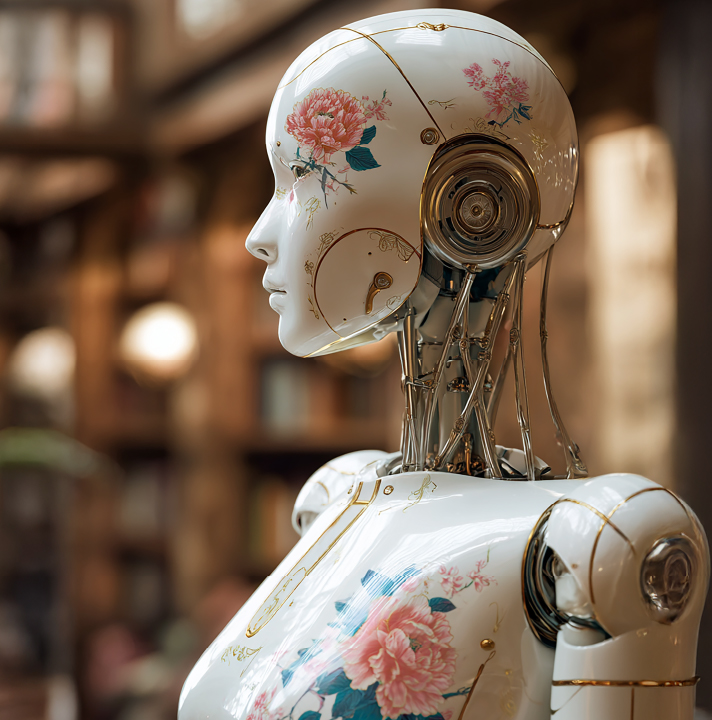
If Physical AI were to remain as robotic as before, people would dismiss it as “just a machine, not human,” and thus tolerate it much as one might forgive a child for slightly discourteous word choice or tone–as long as the meaning got across. However, as mentioned at the outset, the more AI behaves like a flesh-and-blood human, the more it must choose its words, tone, timing, and pauses appropriately for the situation. Otherwise, as with humans, its intelligence will be called into question.
As noted in this section, in Japanese communication, timing, pauses, word choice, tone, and related aspects are valued as much as the accuracy of information. The ability to read the air and show consideration, so as not to cause discomfort to others, tends to be regarded as a form of intelligence.
What makes this consideration difficult for Physical AI is that the basis for judgment is not words, but atmosphere. In a one-to-one interaction, it may still be possible to instantly recognize patterns in the other person’s movements, tone of voice, or word choice. However, in a setting involving multiple people, where one must read the atmosphere created without words, I cannot imagine what Physical AI could do.
One conceivable phenomenon is that Japanese people, who are good at adapting to others, might instead start tailoring their conversations to Physical AI. Ultimately, I can’t help but feel that even when interacting with other humans, they might begin speaking using the thought processes of Physical AI. Currently, our culture regards “reading the air” as etiquette and intelligent behavior, but in the near future, “pattern recognition” might become the new cool.