Global Perspectives
Along the 7 Line
Board the 7 train at Hudson Yards, among the glass towers of Manhattan’s far west side, and within minutes it dives under the East River and climbs back into daylight above the rooftops of Queens. New Yorkers call it the “International Express,” and the line has been designated a National Millennium Trail for its role in the history of American immigration (American Historical Association). But the story it tells began long before the first train ran in 1915.
In 1643, a French Jesuit named Isaac Jogues passed through New Amsterdam, the Dutch trading post at the tip of Manhattan. Its few hundred residents, the colony’s director told him, spoke eighteen different languages, and that figure, linguist Ross Perlin argues, was probably an underestimate. The first permanent settlers, in 1624, had been Walloon families speaking a language close to French; enslaved Africans likely brought languages such as Kikongo and Kimbundu; Lenape, the language of the land’s original inhabitants, was spoken throughout the Dutch period, and some colonists learned it to act as interpreters (Gotham Center for New York City History). In other words, the city was multilingual before it even spoke English.
The question of how to live together came early too. In 1657, thirty residents of Flushing, then a small town in Dutch-ruled New Netherland, signed a letter to Governor Peter Stuyvesant protesting his ban on Quaker worship, invoking “the law of love, peace and liberty” extending to “Jews, Turks, and Egyptians.” Known as the Flushing Remonstrance, it is widely considered an ancestor of the religious freedom later written into the First Amendment (Religion News Service). Two and a half centuries later, Ellis Island became the great gateway for a much larger wave: Between 1892 and 1954, more than 12 million immigrants passed through its halls, and roughly 40% of Americans today can trace an ancestor through it (National Park Service). Then, in 1965, the Immigration and Nationality Act abolished quotas that had favored northern Europe, and the map of arrivals turned toward Asia, Latin America, and the Caribbean (Pew Research Center).
Today’s New York is the child of that turn. About 3.1 million residents—more than one in three—were born abroad, and two-thirds of New Yorkers are immigrants or the children of immigrants. Immigrants from mainland China, Hong Kong, and Taiwan now share the top rank with those from the Dominican Republic, followed by Jamaica and Mexico; Bangladesh has climbed to seventh place, while Colombia is back in the top ten for the first time since 2000, joined by Ukraine (NYC Department of City Planning).
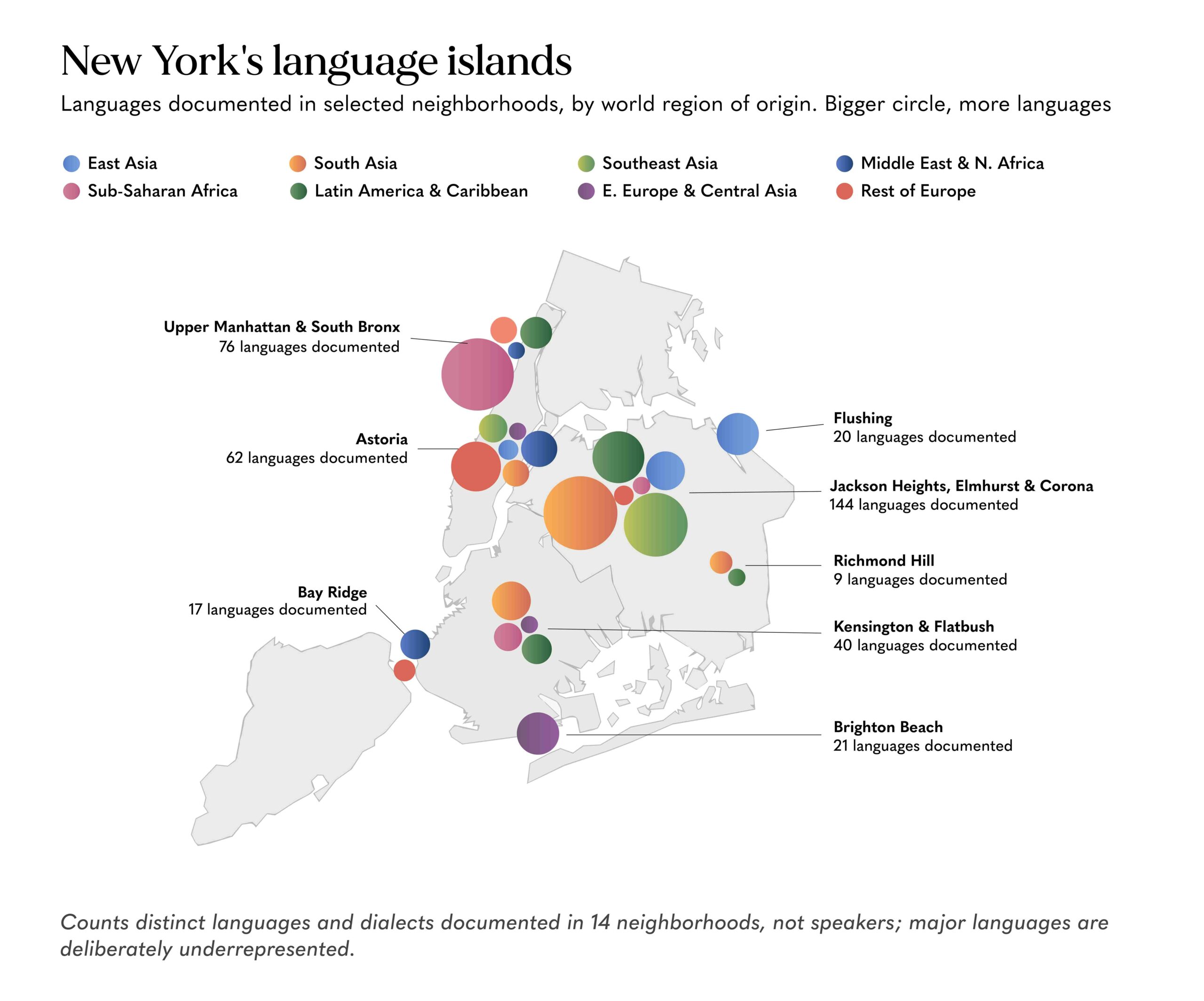
Back on the 7 train, every stop marks a chapter of this story. At 74th Street, in Jackson Heights, the storefronts turn South Asian, which is why the area has long been nicknamed Little India; here the Endangered Language Alliance, a nonprofit that documents Indigenous, minority, and endangered languages, has mapped Bengali, Nepali, and Tibetan alongside Seke, a Himalayan language from Nepal, and Peruvian Quechua (ELA, Jackson Heights). At the end of the line, Flushing, whose Chinatown began to flourish in the 1970s with the arrival of Mandarin-speaking Taiwanese immigrants (Museum of Chinese in America), holds some twenty languages and varieties from China and its neighbors alone, from Wenzhounese to Uyghur (ELA, Flushing). Across the metropolitan area, the Alliance’s map documents more than 800 languages and dialects at over 1,200 significant sites (ELA).
Source: ELA
Above the statistics, this is also the story about who keeps the city running. The skyline behind the window is the image of finance; the neighborhoods below the tracks are home to many of the people who build, cook, drive, and care for the city. According to the city’s 2026 edition of The Newest New Yorkers, which draws primarily on 2023 census survey data, foreign-born residents make up 43% of the city’s workforce (NYC Mayor’s Office). The line between the two worlds is not a clean one: A separate analysis by the New York State Comptroller found that, in 2023, foreign-born residents accounted for 31.8% of the city’s labor force in financial activities and 69.5% in construction. Notably, in 2023 nearly half of New York City’s self-employed workers were born abroad, compared with 23% across the United States, a category that includes small business owners as well as freelance and gig workers (Office of the New York State Comptroller). Thus, the languages heard along Roosevelt Avenue are not just a cultural backdrop: They are written on shop signs, spoken on construction sites, and passed on in family businesses.
Islands and Bridges
Looking at the map as a whole, one thing stands out: New York’s languages are not scattered at random. They gather. West African languages cluster in Harlem and the Bronx; South Brooklyn reads like a microcosm of the former Soviet Union, where Russian and Ukrainian share the streets with Chechen, Volga Tatar, Tuvan, and Buryat in Brighton Beach; Queens holds the many layers of Asia. Each of these clusters rebuilds, a few blocks wide, a world of its own: Its calendar of holidays and fasting months; its opening hours; its mosques, temples, and associations; its own idea of who lends money to whom and who hires whom. The question is what happens when these worlds have to share a school, a subway platform, or a community board.
For the city, the first answer has been translation. Since 2017, Local Law 30 has required covered city agencies that provide direct public services to translate their most commonly distributed documents into ten designated citywide languages, from Spanish and Chinese to Bengali, Haitian Creole, and Urdu, and to offer phone interpretation in at least 100 languages (NYC Mayor’s Office of Immigrant Affairs). Politics has followed: In the 2025 mayoral race, Zohran Mamdani campaigned in several of the city’s languages, with videos and posts in Bengali, Urdu, Arabic, and Spanish (The Tyee).
For the communities themselves, the clusters do two things. They preserve: Languages endangered in their places of origin can survive in a Queens apartment block (Documented NY). And they can turn from a survival strategy into a springboard. Inheriting the City, published in 2008, drew on a decade-long research project involving more than 3,000 young people in metropolitan New York, including children of immigrants and native-born comparison groups. It found that many of the immigrant-origin groups studied matched or outperformed their comparison groups in education and economic attainment, helped in part by high family expectations and by community networks that some families used to navigate the city’s schools (NPR).
About 3.1 million residents—more than one in three—were born abroad, and two-thirds of New Yorkers are immigrants or the children of immigrants
The Bengali-speaking community shows how an island can also become a bridge. Its first New Yorkers lived on no island at all. As historian Vivek Bald of MIT has reconstructed in Bengali Harlem, peddlers from Bengal selling embroidered silks began arriving at the end of the nineteenth century, followed in the 1910s and 1920s by seamen who left British ships for shore work (MIT). Many settled in Harlem, married into its African American and Puerto Rican families and sold halal hot dogs on 125th Street (MIT Comparative Media Studies). Today the community is far larger and more visible, from Jackson Heights in Queens to Parkchester in the Bronx and Kensington in Brooklyn, where a stretch of McDonald Avenue was co-named “Little Bangladesh” in 2022 (NYC Council).
Seen up close, though, the Bangladeshi community is an archipelago. ELA’s Jackson Heights map lists not only Bengali and Sylheti but also Chakma, Marma, and Tanchangya, languages associated with Indigenous communities of the Chittagong Hill Tracts. Differences of region, language, and origin do not disappear in New York, but proximity can create opportunities for contact. What divides a community in its homeland can become what holds it together.
Along the Canal
To understand the rest of the state, one has to follow a different line. Opened in 1825, the original Erie Canal stretched 363 miles from Buffalo, on Lake Erie, to Albany on the Hudson, passing through Rochester, Syracuse, and Utica, and linking the Great Lakes to the Atlantic by way of the Port of New York (Britannica). In 2025, the state celebrated its bicentennial, with a replica of the Seneca Chief, which carried Governor DeWitt Clinton on the inaugural voyage, retracing the route from Buffalo to New York City (New York State Canal Corporation). Two centuries later, many of the towns along its banks face a quieter challenge: holding on to their population.
The state-wide numbers are striking. Between July 2024 and July 2025, New York State’s population increased by just 1,008. Net international migration added 95,634 residents, while net domestic migration reduced the population by 137,586 (Cornell Program on Applied Demographics, on Census Bureau estimates). In Erie County, home to Buffalo, deaths outnumbered births over the same period, while net domestic migration was negative. International migration kept the overall migration balance just above zero, but the county’s total population still fell.
Down the Hudson, in New York City, the pressure takes a different form. In the 2023 Housing and Vacancy Survey, New York City’s net rental vacancy rate was 1.41%, the lowest since the 1968 survey; among units renting for less than $1,100 a month, it fell to 0.39% (NYC Department of Housing Preservation and Development). The survey is conducted roughly every three years, and the 2023 edition remains the latest available (NYC Rent Guidelines Board). In an article published in 2025, a Bengali resident of Borough Park, next to Kensington, recalled seeing neighbors move during the pandemic to the Bronx “or even Buffalo for cheaper housing” (Harlem View).
Buffalo has actually drawn Bengali New Yorkers for about twenty years. According to a 2016 fact sheet by the Buffalo nonprofit Partnership for the Public Good, Nazmal Bhuiyan, a New York City taxi driver, bought a house to renovate on Woltz Avenue, on Buffalo’s East Side, for $4,500 at a tax-foreclosure auction, and is said to have persuaded some 200 families to follow him. The same fact sheet, citing reporting from 2015, stated that 91% of the owners and operators of one local taxi company, Liberty Yellow Taxi, were Bangladeshi (Partnership for the Public Good). Further east along the canal, Utica has built a similar reputation, welcoming Bosnian refugees from the wars of the 1990s and Karen refugees from Burma (PBS NewsHour).
Much of Mamdani’s multilingual campaign carried a single message: affordability (The Tyee). That it was delivered in Bengali, Urdu, Arabic and Spanish says something about who feels the cost of the city most. The figures available do not show a mass departure of immigrant workers from New York City, but the housing data and individual stories point to a question for the years ahead. If the city does not become more accessible, can it hold on to the people who have powered such a large share of its economy—and of its wealth—for decades, and who are now part of its very fabric? Or will more of that workforce, and its languages, follow the canal toward the towns that need them?