South America
To which language should you translate to localize in Peru?
LANGUAGE INSIGHT
Official language
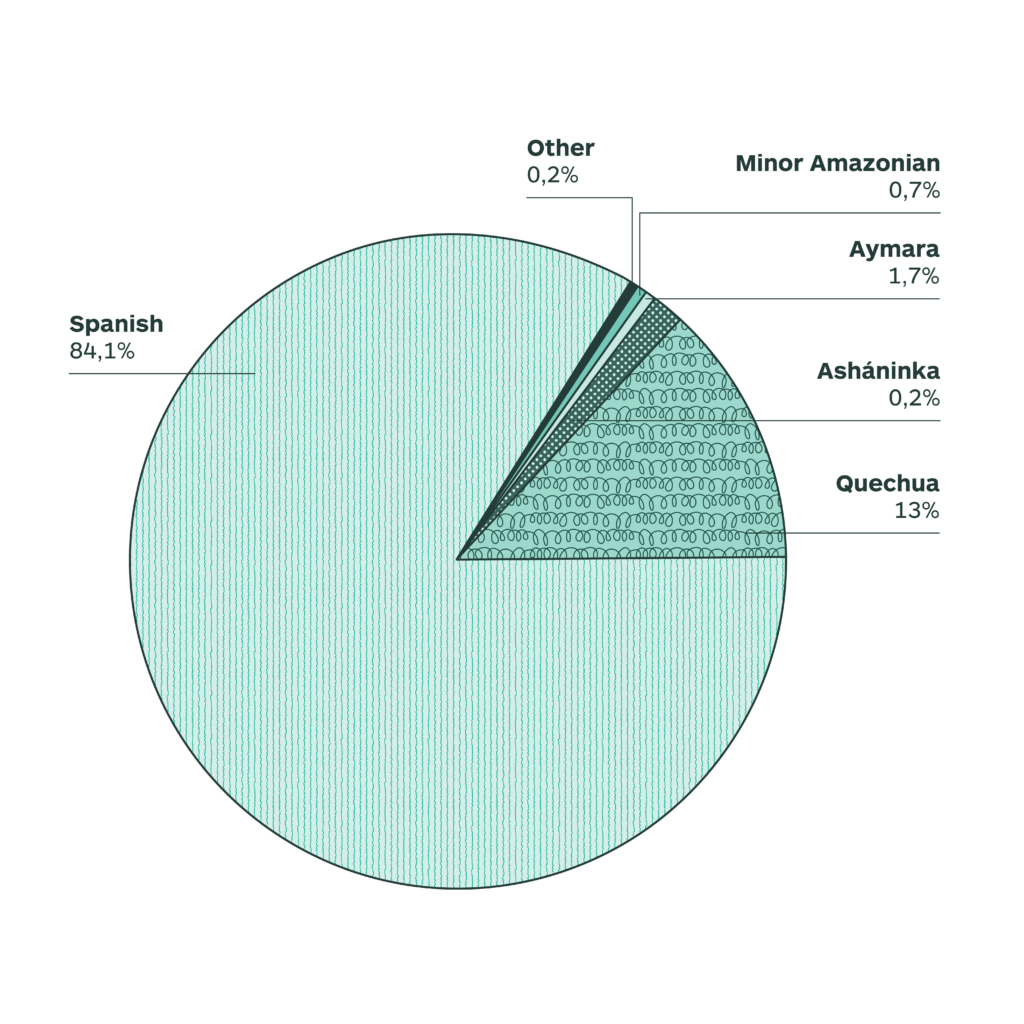
Spanish (84.1%; 28.46 mln), Quechua (13%; 4.39 mln), Aymara (1.7%; 575k).
Actual languages
Spanish (84.1%; 28.46 mln), Quechua (13%; 4.39 mln), Aymara (1.7%; 575k), Ashaninka (0.3%; 101k), other (0.9%; 304k).
What the top 150 best localized websites in the world do in Peru
(Top 150 websites listed in the Global by Design ranking – published annually by Byte Level Research, this report provides a list of globally localized websites, showcasing best practices and emerging trends in their globalization)
- 92/150 localize by translating into Spanish
- 3/150 localize by translating into LatAm Spanish
- 1/150 localizes by translating into LatAm Spanish, French and Simplified Chinese
- 1/150 localizes by translating into Spanish, Aymara, Quechua, Ashaninka and Peruvian Sign Language
- 1/150 localizes by translating into Spanish, Aiimara, Kichwa and Quechua
- 1/150 localizes by translating into Spanish, French, Portuguese, Italian, German, Simplified Chinese, Traditional Chinese, Japanese, Thai, Ukrainian, Russian, Turkish, Romanian, Polish, Hungarian and Bahasa Indonesia
-
 3M
3M
-
ABB
-
Accenture
-
Adidas
-
Adobe
-
Airbnb
-
Aldi
-
Amazon
-
American Airlines
-
American Express
-
Apple
-
Audi
-
Autodesk
-
Avis
-
Bayer
-
BMW
-
Booking.com
-
Bosch
-
British Airways
-
Bumble
-
Burberry
-
BYD
-
Canon
-
Capgemini
-
Cartier
-
Caterpillar
-
Chevrolet
-
Cisco Systems
-
Citibank
-
Coca-Cola
-
Costco
-
Dell
-
Deloitte
-
Delta
-
DHL
-
Disney+
-
Dyson
-
eBay
-
Eli Lilly
-
Emirates
-
Ernst & Young
-
Facebook
-
FedEx
-
Ford
-
Four Seasons
-
Fujifilm
-
GE
-
Gillette
-
GoDaddy
-
Google
-
Gucci
-
Haier
-
Heineken
-
Hermès
-
Hertz
-
Hilton
-
Hisense
-
Hitachi
-
Honda
-
Hotels.com
-
HP
-
HP Enterprise
-
HSBC
-
Huawei
-
Hyatt
-
Hyundai
-
IBM
-
IKEA
-
Intel
-
InterContinental Hotels
-
J&J
-
Jack Daniel's
-
Jehovah’s Witnesses
-
John Deere
-
Kellogg's
-
Kia
-
KPMG
-
L'Oréal
-
Land Rover
-
LEGO
-
Lenovo
-
Lexus
-
LG
-
Louis Vuitton
-
Lululemon
-
LUSH
-
Marriott
-
MasterCard
-
McDonald's
-
Mercedes-Benz
-
Merck
-
Microsoft
-
Mitsubishi Electric
-
Nestlé
-
Netflix
-
Nike
-
Nikon
-
Nintendo
-
Nio
-
Nissan
-
NIVEA
-
Oracle
-
Pampers
-
Panasonic
-
PayPal
-
Pepsi
-
Pfizer
-
Philips
-
Pitney Bowes
-
Porsche
-
Procter & Gamble
-
PWC
-
Revolut
-
Rolex
-
Royal Caribbean
-
Salesforce
-
Samsung
-
Sanofi
-
SAP
-
Sephora
-
Shopify
-
Siemens
-
Sony
-
Spotify
-
Starbucks
-
Steelcase
-
Stripe
-
Subaru
-
Tesla
-
The Church of Jesus Christ of Latter-day Saints
-
Tiffany
-
Tinder
-
Toshiba
-
Toyota
-
TripAdvisor
-
Uber
-
United Airlines
-
UPS
-
Visa
-
Volkswagen
-
Volvo Cars
-
Vrbo
-
Walmart
-
Western Union
-
Wikipedia
-
Wise
-
WordPress
-
Workday
-
Xerox
-
Xiaomi (Mi)
-
Zara
-
Zoom


If you need others information, below you can find a selection of economic/social/cultural data
Overview
Language
Official language
Spanish (84.1%), Quechua (13%), Aymara (1.7%).
T-index
0.27%
T-Index ranks countries according to their potential for online sales.
Indigenous languages
Quechua (13%), Aymara (1.7%).
English
Moderate proficiency (EF) – 53 of 116 countries/regions in the world- 10/21 position in Latin America.
Demography
Capital: Lima
Currency: Sol
Population: 33.84 mln
Population density: 26/km2
Economy
GDP: 267.6 billion USD (2023)
GDP per capita: 7,906.6 USD (2023)
Exports: $64.8 billion (2023)
Statistics
Internet users: 79.5% penetration, 24.5 million
Unemployment rate: 4.8% (2024)
Urbanisation: 79% (2023)
Literacy: 94% (2020)
Conventions
Numbering system
Arabic numerals and comma as decimal separator
Date format: yyyy-mm-dd / dd-mm-yyyy
Time: 24h time system
Country code: 0051
Language data sources: Worldatlas/Britannica//EF/Wikipedia; Demography data sources: IMF/Worldometers; Conventions data source: Wikipedia; Economy data sources: WTO/OEC/CIA/Esomar/Datareportal; Statistics data sources: Datareportal/WorldBank/UN/UNESCO/CEIC/IMF/Culturalatlas/Commisceoglobal/Worlddata.info
Facts and data
Economy
Imports
$51.5 billion (2023). Refined Petroleum ($5.6B), Crude Petroleum ($3.08B), Cars ($1.9B), Delivery Trucks ($1.49B), and Broadcasting Equipment ($1.42B).
The top origins were China ($13.8B), United States ($11.1B), Brazil ($3.63B), Argentina ($2.55B), and Mexico ($1.74B).
Financial inclusion factors (over 15 years of age)
• 56.3% have an account with a financial institution
• 12.9% have a credit card
• 14.3% have a mobile money account
• 11.4% make online purchases
Ease of doing business
Ease of conducting business is moderately high (rated 68.7 out of 100). Ranked 5th out of 32 Latin American & Caribbean countries. Ranked 74th out of 190 countries worldwide (2024, World Bank).
Exports
$64.8 billion (2023). Copper Ore ($19.9B), Gold ($8.92B), Refined Copper ($2.79B), Refined Petroleum ($2.06B), and Grapes ($1.99B).
The top destinations were China ($22.5B), United States ($9.3B), Canada ($3.24B), India ($2.62B), and Switzerland ($2.42B).
In the latest year, Peru was the world’s largest exporter of Grapes ($1.98B), Zinc Ore ($1.73B), and Lake Pigments ($67.6M).
Main local online stores
Mercado Libre, Amazon and saga falabella.com.pe. Other top retail sites include eBay, alibaba.com, apple.com, Linio Sites, Buscape Company, cineplanet.com.pe and ripley.com.pe
Economic freedom
‘Moderately free’ (rated 65.9 out of 100). Ranked 9th out of 32 American countries. Ranked 54th out of 184 countries worldwide (2025, Heritage Foundation and Wall Street Journal).
Global Innovation Index
Ranked 8th out of 19 Latin American and Caribbean countries, 76th out of 132 worldwide.
The Global Innovation Index captures the innovation
ecosystem performance of 132 economies and tracks the most recent global innovation trends.
Economy data sources: WTO/OEC/CIA/Esomar/Datareportal
Service Imports (2018)
Service Exports (2018)
Source: OEC
Trade balance of goods from 2013 to 2023
Source: Statista
Historical Data Trade Imports
The following section uses historical trade data imports from partners of Peru.
Historical Data Trade Exports
The following section uses historical trade data exports from partners of Peru.
Source: OEC
The Top Export Opportunities for Peru by Relatedness
Relatedness measures the distance between a country's current exports and each product by showing only products that Peru is not specialized in.
Peru's Most Complex Exports
The Product Complexity Index (PCI) measures the knowledge intensity of a product by considering the knowledge intensity of its exporters.
Source: OEC
Peru's Most Specialized Products
Specialization is measured using Revealed Comparative Advantage (RCA), an index that takes the ratio between Peru observed and expected exports in each product.
Source: OEC
Perception of products made in selected countries in 2017
Source: Statista
Which attributes do you associate with products made in Peru?
Source: Statista
Market Growth Imports (2018)
This score represents the likelihood that the given country will start importing that product in the next few years. It forecasts the opening of a new specific market.
Market Growth Exports (2018)
This score represents the likelihood that the given country will start exporting that product in the next few years. It forecasts the opening of a new specific market.
Source: OEC
Foreign direct investment, net inflows (% of GDP)
Source: WorldBank
Number of financial operations in Peru in 2017, by payment method
Source: Camara De Comercio De Lima

T-index
Reach most of the online purchasing power
T-Index ranks countries according to their potential for online sales. It estimates the market share of each country in relation to global e-commerce.
Try it nowMedia
Media language Spanish
Information channels
Privately-owned outlets dominate the media scene, with state media having smaller audiences. Lima is home to dozens of radio stations and several TV networks. Radio is an important news source, particularly in rural areas. The use of criminal defamation charges against journalists is the main threat to media freedom, says Reporters Without Borders (RSF). Journalists are susceptible to threats and physical attacks, especially when covering corruption, says Freedom House. Media ownership is highly concentrated. RSF says Grupo El Comercio controls most national print titles and a major national TV network.
The press
El Comercio – Lima daily
Gestion – Lima daily
Ojo – Lima daily
El Bocon – Lima daily
La Republica – Lima daily
Diario Correo – daily, 15 local editions
Television
TV Peru – state-owned
America TV – commercial
Panamericana – commercial
ATV – commercial
Latina – commercial
Radio
Radio Programas de Peru (RPP) – popular Lima-based news and talk station
Radio Panamericana – Lima commercial FM station, music
Radio Nacional – state-run
News agency
Andina – government-owned
Peruvian Times – English-language
Media data source: BBC
Internet Data
Internet users
79.5% penetration, 27.3 million
Share of web traffic by device
47.40% mobile phones, 51.83% computers (laptops and desktops), 0.75% tablet devices and 0.01% other devices
Median speed of mobile Internet connection
22.71 Mbps
Median speed of fixed Internet connection
191.53 Mbps
Mobile connection as a percentage of total population: 115%
Percentage of mobile connections that are broadband (3G-5G): 92.7%
Most popular web search engines
Google (92.78%), Bing (4.17%), Yahoo! (2.64%), Yandex (0.2%), DuckDuckGo (0.11%), other (0.1%).
Most used social media
Facebook (62.7%), Pinterest (14.79%), Instagram (10.86%), YouTube (7.91%), Twitter (2.62%), Reddit (0.54%), LinkedIn (0.27%), other (0.3%)
Internet data sources: Datareportal/Statcounter
Distribution of online transactions in Peru in 2018, by device
Source: Picodi
Social statistics
Life expectancy
78 yrs (2023)
Corruption perceptions Index
Peru scored 31 out of 100, ranked 127 out of 180 countries worldwide.
Current health expenditure
6.09% of GDP
Current education expenditure
82.8% of total expenditure in public institutions
CO2 emissions
1.84 metric tons per capita
World Happiness Index
Peru ranked 74 out of 146 countries, with a score of 5.559.
Religion
The Peruvian Constitution allows freedom of religion. The major religion in Peru is Roman Catholicism which was first introduced by Spanish conquistadors and then imposed by Colonial and Republican rule. Evangelical churches have been noticeably increasing since the 70’s. Peruvian Catholicism is practiced distinctly in two domains. The first, oriented more to European and North American Values such as modernity, progress and globalism is practiced in urban areas. The second one, associated with pre-modernity, native traditions, rural background, poverty, etc., is practiced in Andean and rural regions, as well as in suburban marginalised areas. Andean and popular religiosity has a holistic worldview that also includes cultural, social and spiritual values and practices. This concept has its roots in pre-Columbian polytheistic and theocratic religions and systems of belief. Despite the official dogma of the Catholic Church, Peruvian Catholicism is the result of five hundred years of syncretism. This is especially evident in the Andes, in rural regions and, in the last decades, in marginalized urban areas where millions of Andean migrants live. In real life, a Peruvian can go to church on Sunday to celebrate official Catholic rituals, but at the same time he or she can rely on and still practice Andean rituals related to health and spiritual healing.
The official Catholic Church has influence in current political and social life. For example, Catholic leaders still intervene in decision-making laws by influencing the vote against abortion and gay and lesbian rights.
Peruvians in general are spiritual, whether they are members of a church or not. A key factor to remember when approaching Peruvians is that spirituality is an important part of their identity and cultural background.
Social statistics sources: WorldBank/UN/UNESCO/CEIC/IMF
Tertiary education in Perù, by sex
Tertiary education in Perù
Source: UNESCO
Country Curiosities
Peru’s linguistic tapestry is as vibrant as its culture, with Spanish sharing official status alongside Quechua and Aymara—two languages rooted deep in the country’s indigenous past. Beyond these, 43 native tongues continue to thrive. Quechua, once the language of the mighty Incas, remains alive and spoken daily, carrying centuries of Andean wisdom. Its unique words like “ayni,” meaning mutual aid, reveal a world built on community and cooperation. Far from being a relic, Quechua pulses through modern music, with artists like Renata Flores Rivera, the “Queen of Quechua rap,” blending ancient language and contemporary beats to keep tradition fresh and powerful.
Additionally…
- “Soy más Peruano que la papa”: the potato originated in Peru, with over 3,000 varieties still grown today.
- Peru ranks seventh globally in gold production and is a leading producer of silver and copper worldwide.
- In 2022, it was the largest exporter of animal meal, grapes, and fish oil.
- The third largest and most populous country in South America.
- The Spanish named “Peru” after a river near Panama, while the Inca called their empire “Tawantinsuyu,” meaning “the four united provinces.”
- Indigenous peoples are the world’s largest landholders, occupying vast parts of the Amazon rainforest.
- The Peruvian culinary scene is richly influenced by African, Chinese, and Japanese communities.
- Lima is the world’s second-largest desert city, after Cairo.
- The country operates on Peruvian Time (UTC-5) year-round, with no daylight saving time.
- Peruvian culture uniquely blends Catholicism and indigenous beliefs.
The Data Factbook is a work in progress project. Our community is helping us to fill it up always with new and updated data. Your contribution is precious. If you want to help us, please write your advices at imminent@translated.com
Languages research
Languages in Perù
The geographical distribution of languages that you will find in the maps published in this section is a work in progress. Our community is helping us to fill it up with always new and updated data. Your contribution is precious. If you want to help us, please write to imminent.factbook@translated.com
Photo credit: Willian Justen de Vasconcellos, Unsplash