Global Perspectives
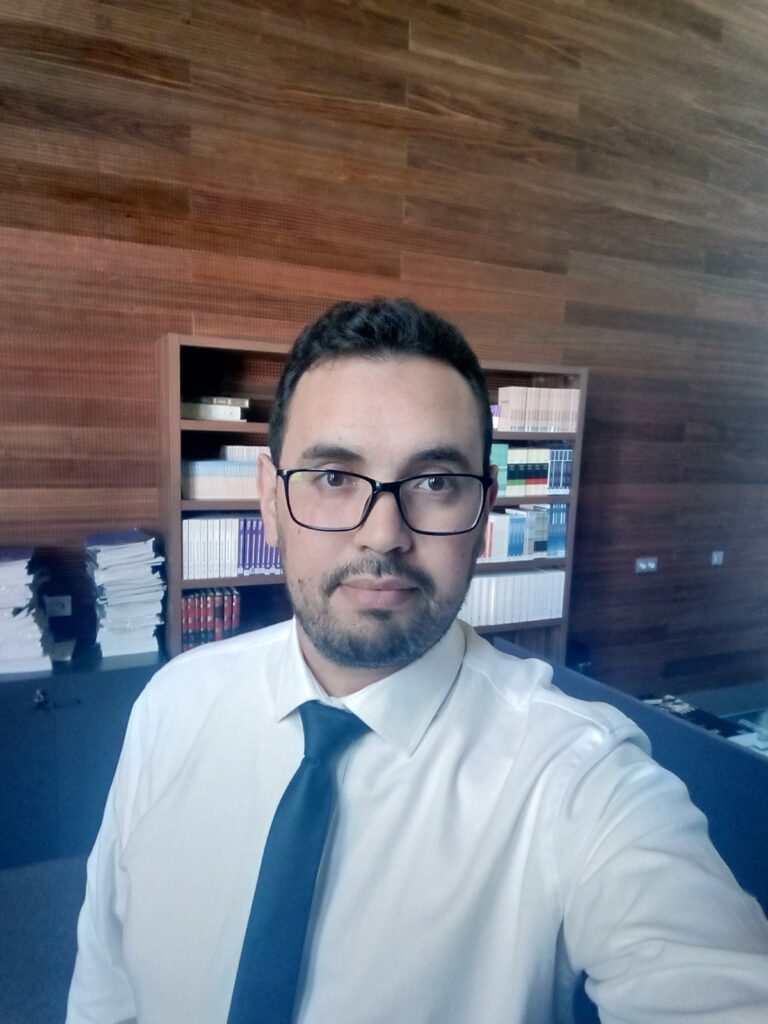
Badre Ghiyati
Professional librarian, Translator, and content Writer
Badre Ghiyati is a professional Librarian/Documentalist, Translator, and Content Writer specializing in Arabic, French, and English. With over 11 years of experience, he has collaborated with both national and international translation platforms, including Translated, delivering high-quality linguistic services that ensure a precise and nuanced understanding of documents.Alongside translation work, Badre Ghiyati has worked within academic institutions, universities, governmental libraries, with core responsibilities including managing cataloging, classification, assisting patrons, research documentation, and managing resources (print and digital).
Overview
– Country: Morocco
– Key Concepts: Futurity, ghadi/gha, divine will (InshāʾAllāh), reciprocity, patience (ṣabr), trust (tawakkul)
– Temporal Orientation: Projective yet contingent; forward movement moderated by divine will and cyclical expectation
– Historical Influences: Amazigh cosmology, Islamic theology, Arabic grammar, colonial administration, globalization and digital culture
Introduction
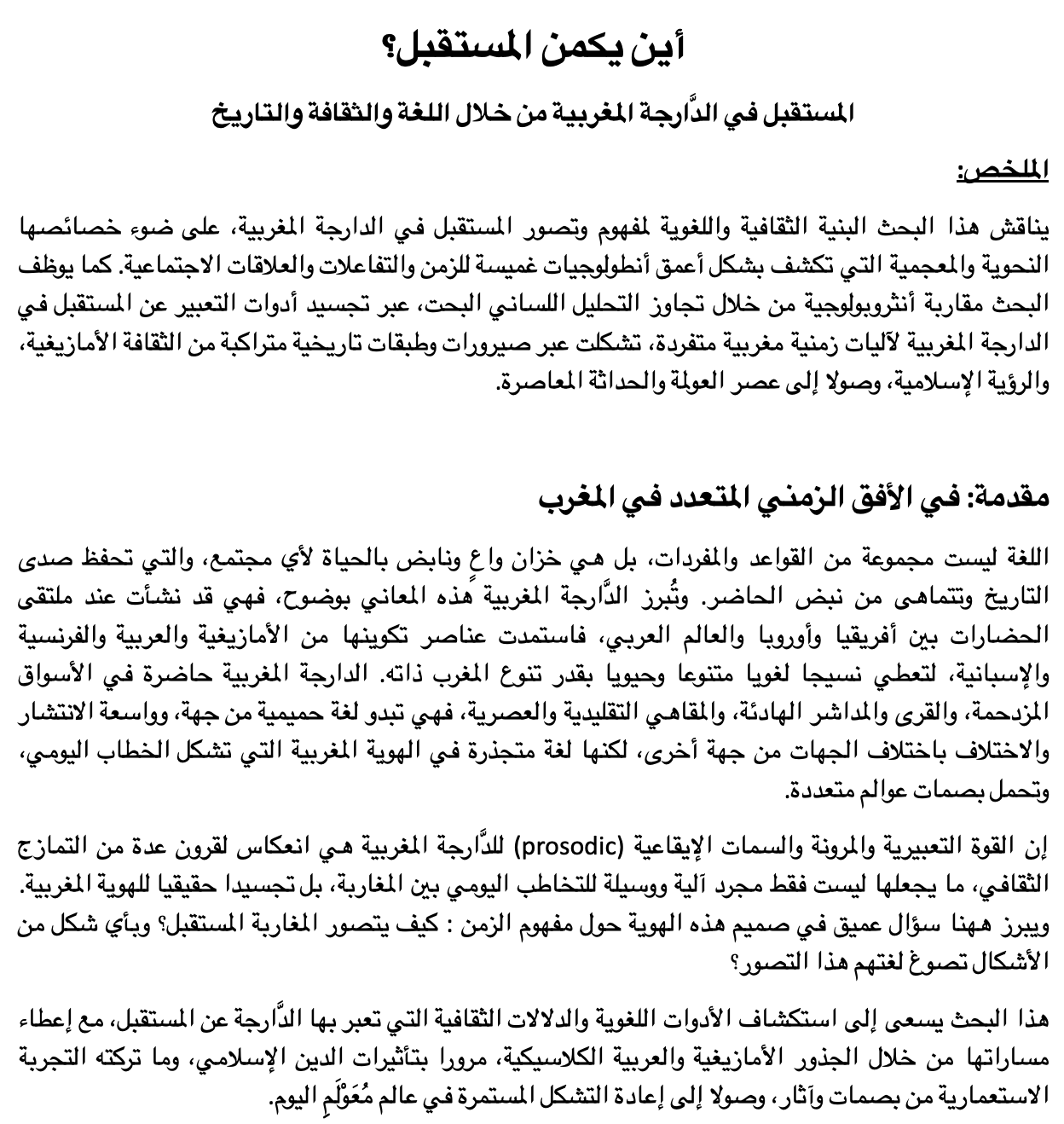
Language is never merely a system of grammar and vocabulary. It is a repository of memory, a living archive through which communities negotiate their past, inhabit their present, and imagine what lies ahead. Moroccan Darija (الدَّارجة المغربية) embodies this function with particular intensity.
Formed at the crossroads of Africa, Europe, and the Arab world, Darija draws from Amazigh foundations, Arabic grammatical structures, and successive layers of French, Spanish, and English influence. Spoken in rural villages, bustling souks, and contemporary urban cafés (المقاهي), it is both intimate and expansive: deeply rooted in Moroccan social life while constantly absorbing external currents.
Within this linguistic density emerges a central question: how do Moroccans imagine the future? Darija does not offer a single answer. Instead, it articulates futurity as a layered and negotiated domain, where intention, belief, patience, and uncertainty coexist. To speak about the future in Darija is not simply to locate an event in time, but to position oneself ethically and socially within a world shaped by history, faith, and contingency.
Amazigh Temporal Foundations: Cycles Before Horizons
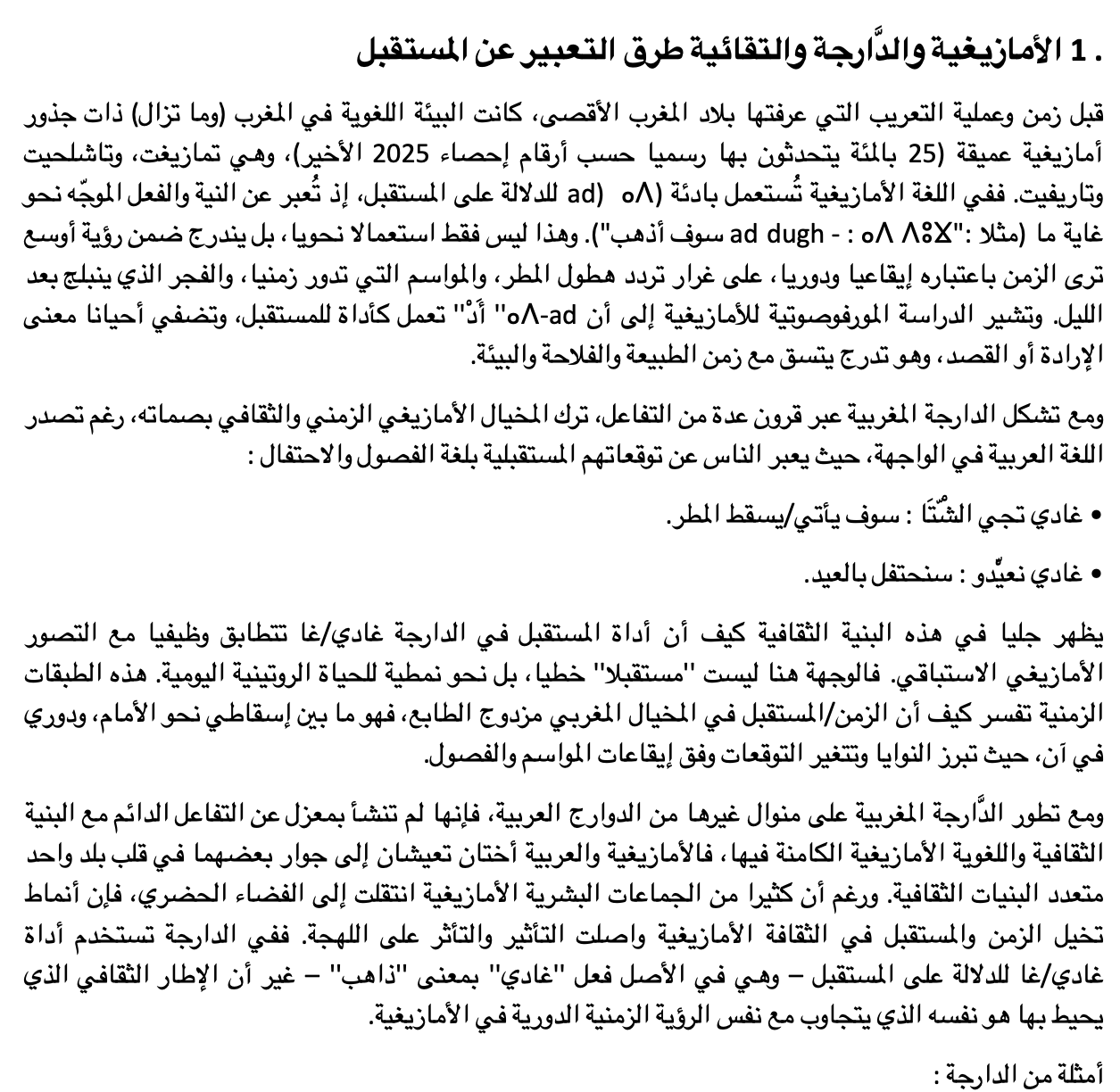
Any exploration of futurity in Darija must begin with its Amazigh substratum. Long before the spread of Arabic, Morocco’s temporal imagination was shaped by Amazigh cosmologies in which time unfolds rhythmically rather than linearly. In Amazigh languages such as Tamazight, Tachelhit, and Tarifit, the future is commonly marked by the particle ad, which expresses intention and oriented action:
- ad dugh (ⴰⴷⴰⴷⵓⴴ) — “I will go”
This marker does more than project an action forward. It reflects a worldview grounded in ecological recurrence: rains return, harvests repeat, and seasons rotate. Linguistically classified as a future or irrealis marker, ad often carries a modal nuance, emphasizing intention within a world governed by cyclical patterns rather than absolute prediction.
As Darija emerged through sustained contact between Amazigh and Arabic-speaking populations, this cyclical imagination of time persisted, even as Arabic became the dominant linguistic frame. In many rural contexts, Darija speakers continue to frame the future as the return of expected events:
- ghadi tji sh-tta — “the rain will come”
- ghadi nʿaydo — “we will celebrate the feast”
Here, futurity is not conceived as a distant, abstract horizon, but as the reappearance of patterned life. This helps explain why Moroccan temporality remains simultaneously projective and cyclical: actions move forward, yet expectations remain anchored in recurrence.
Islamic Time: Humility, Certainty, and Moral Orientation
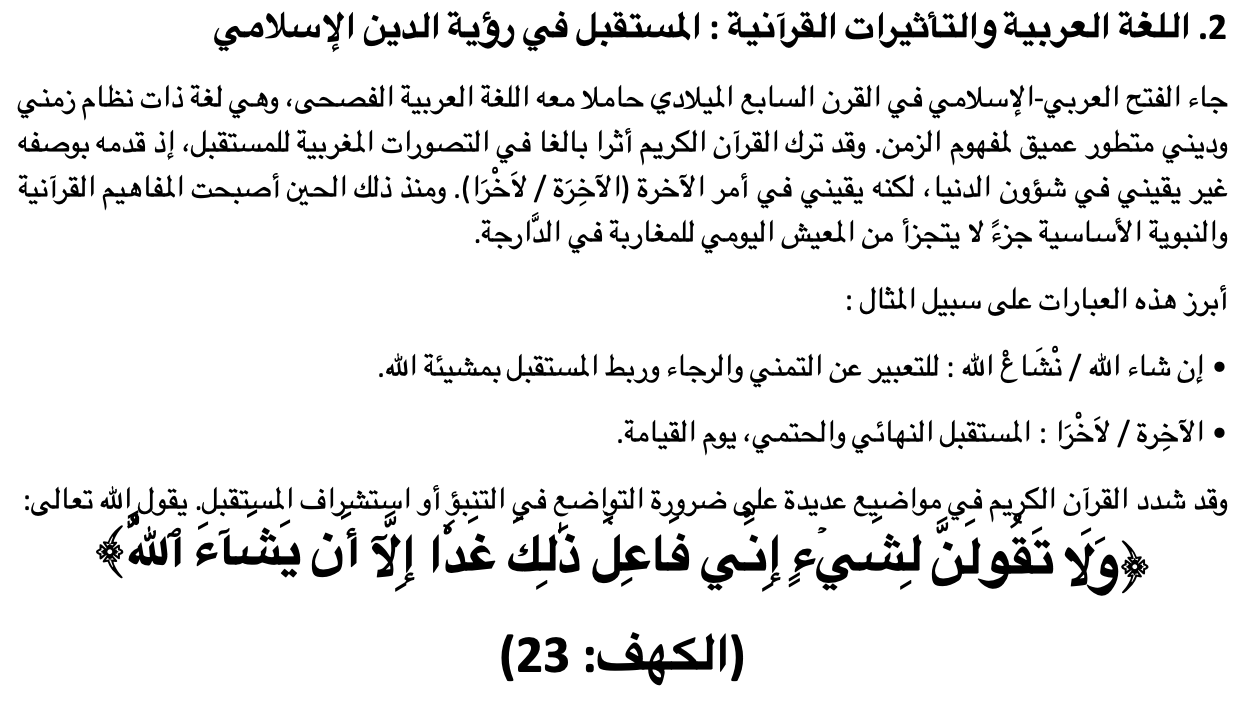
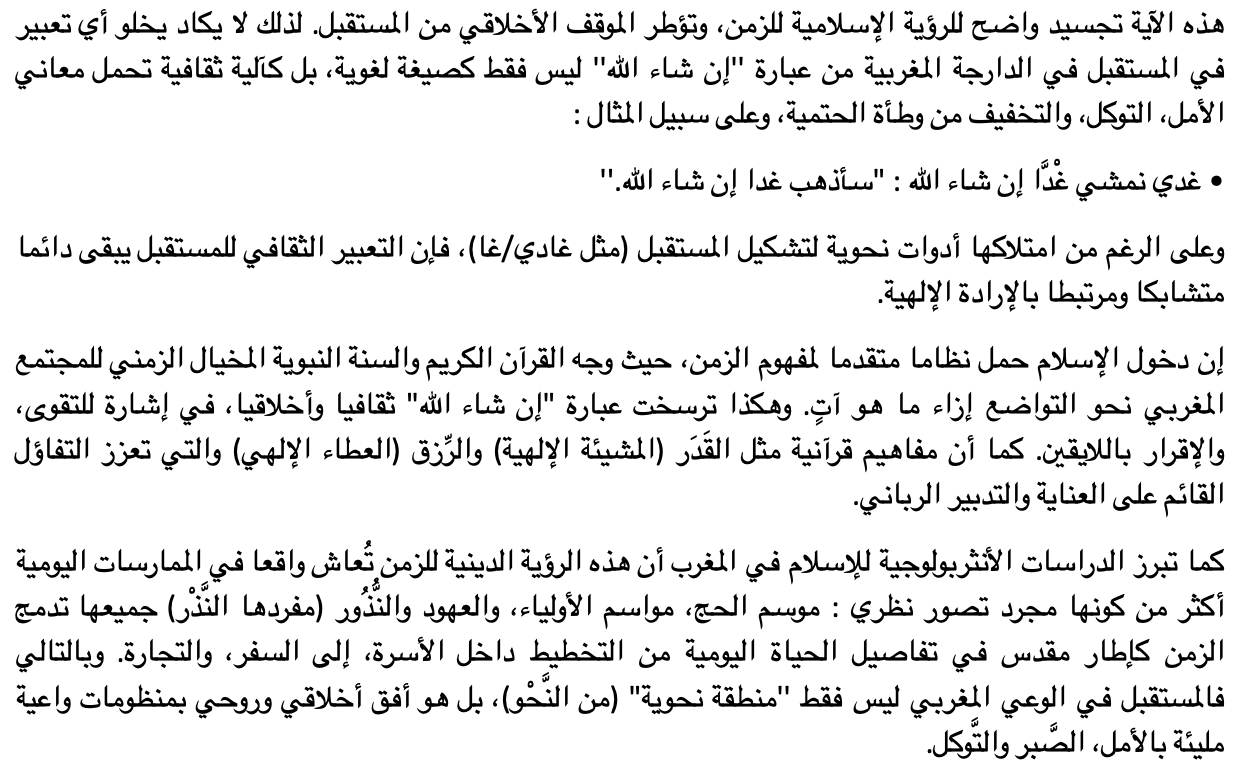
A foundational Qur’anic injunction captures this stance succinctly:
“Do not say of anything, ‘Indeed, I will do that tomorrow,’ except [by adding], ‘If God wills.’”
(Qur’an 18:23)
In Moroccan daily life, future statements are rarely uttered without this acknowledgment of divine will. InshāʾAllāh is not a simple linguistic habit; it is a moral positioning. It tempers certainty, softens obligation, and situates human intention within a larger metaphysical order.
Crucially, this religious temporality is not abstract. Pilgrimage cycles, fasting periods, saintly calendars, and vows (nadrالنذر) weave sacred time into decisions about work, travel, marriage, and migration. The future becomes a moral horizon, shaped by patience (ṣabr) and trust (tawakkul), rather than a space of pure control.
The Islamic expansion of the 7th century introduced Classical Arabic and a religious philosophy that profoundly reshaped Moroccan conceptions of time. The Qur’anic worldview distinguishes sharply between the uncertainty of worldly futures and the certainty of the ultimate future: al-ākhira / l-ākhra (الآخرة).
This theology entered everyday Darija through expressions that continue to structure future-oriented speech:
- InshāʾAllāh / nšāllah — “If God wills”
- fīd Allāh — “in God’s hand”
- lli ktebha Allah tkūn — “what God has written will be”
Everyday Futurity: Endurance, Hope, and Social Balance
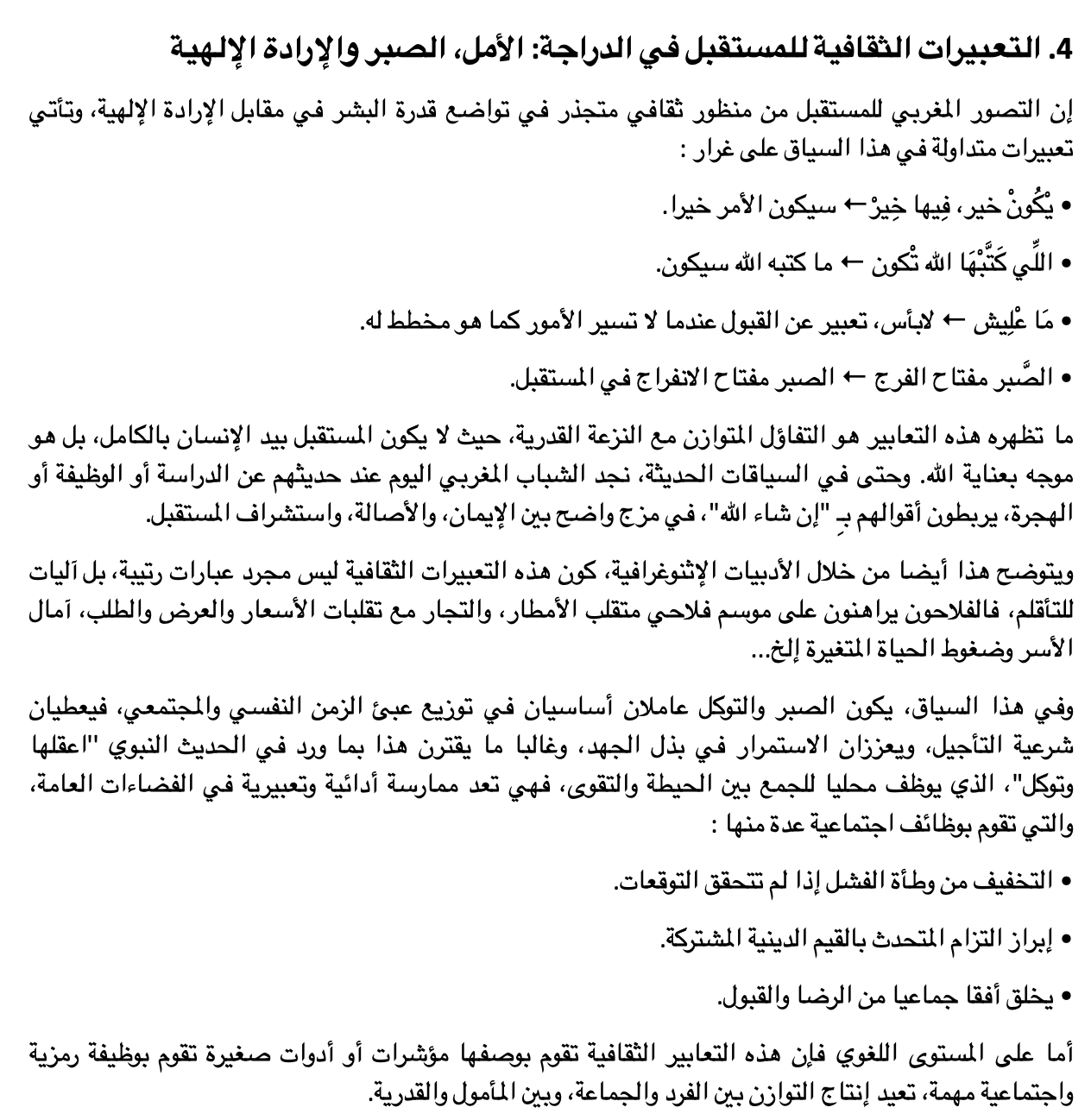
These theological orientations further surface in the everyday idioms through which Moroccans negotiate uncertainty:
- ykūn khīr / fīha khīr — “it will be for the best”
- ṣ-ṣbr mftāḥ l-fraj — “patience is the key to relief”
Such expressions articulate a worldview in which the future is meaningful but not fully governable. They function as cultural tools for endurance in contexts shaped by seasonal economies, migration, fluctuating markets, and delayed opportunity.
Public invocations of the divine will also perform important social work. They mitigate blame when plans fail, align speakers with shared religious norms, and distribute responsibility across time and community. Linguistically modest, these expressions carry significant sociological weight.
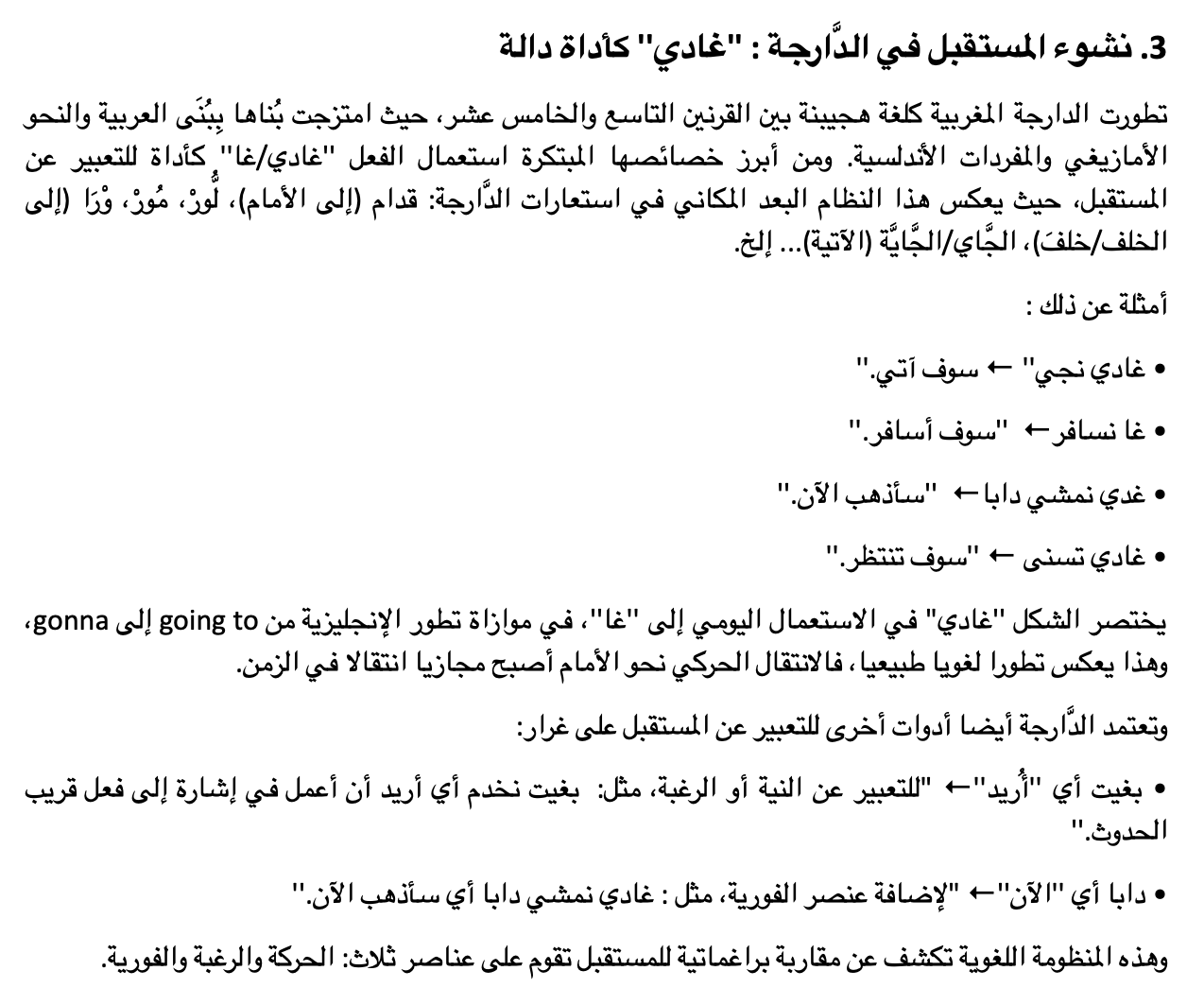
Within this ethical and cultural framework, Darija developed a distinctive grammatical mechanism for expressing futurity. The particle ghadi / gha (غادي / غا), originally meaning “going,” functions as a future marker:
- ghadi nji — “I will come”
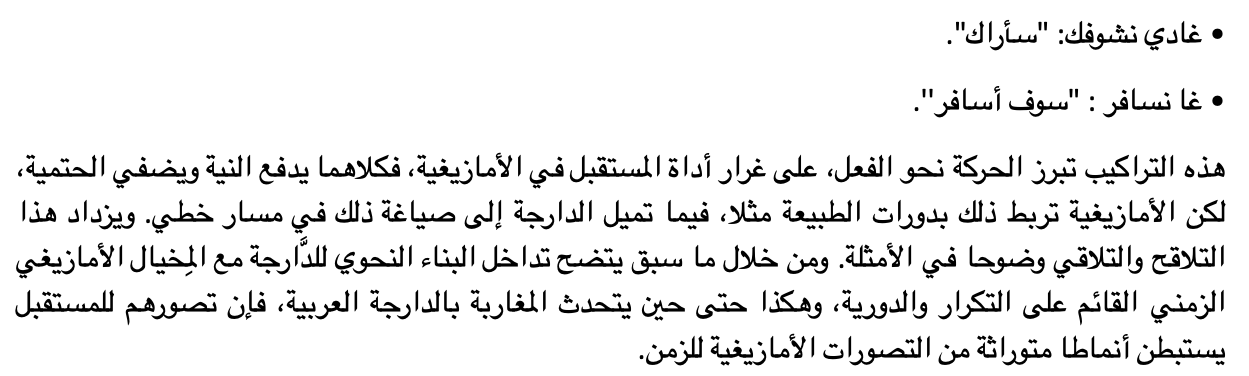
- gha nsāfer — “I will travel”
- ghadi nmshi daba — “I will go now”
Often shortened to gha, this evolution mirrors English “going to → gonna.” Spatial movement becomes temporal projection, framing the future as a path one moves toward, rather than a fixed destination.
Darija further refines this motion-based futurity through markers of desire and immediacy:
- bghit — “I want” (intention oriented toward the near future)
- daba — “now” (compressing future action into the present)
Together, these forms reveal a pragmatic conception of the future: intention, movement, and action are inseparable, yet always subject to contingency.
Colonial and Global Horizons
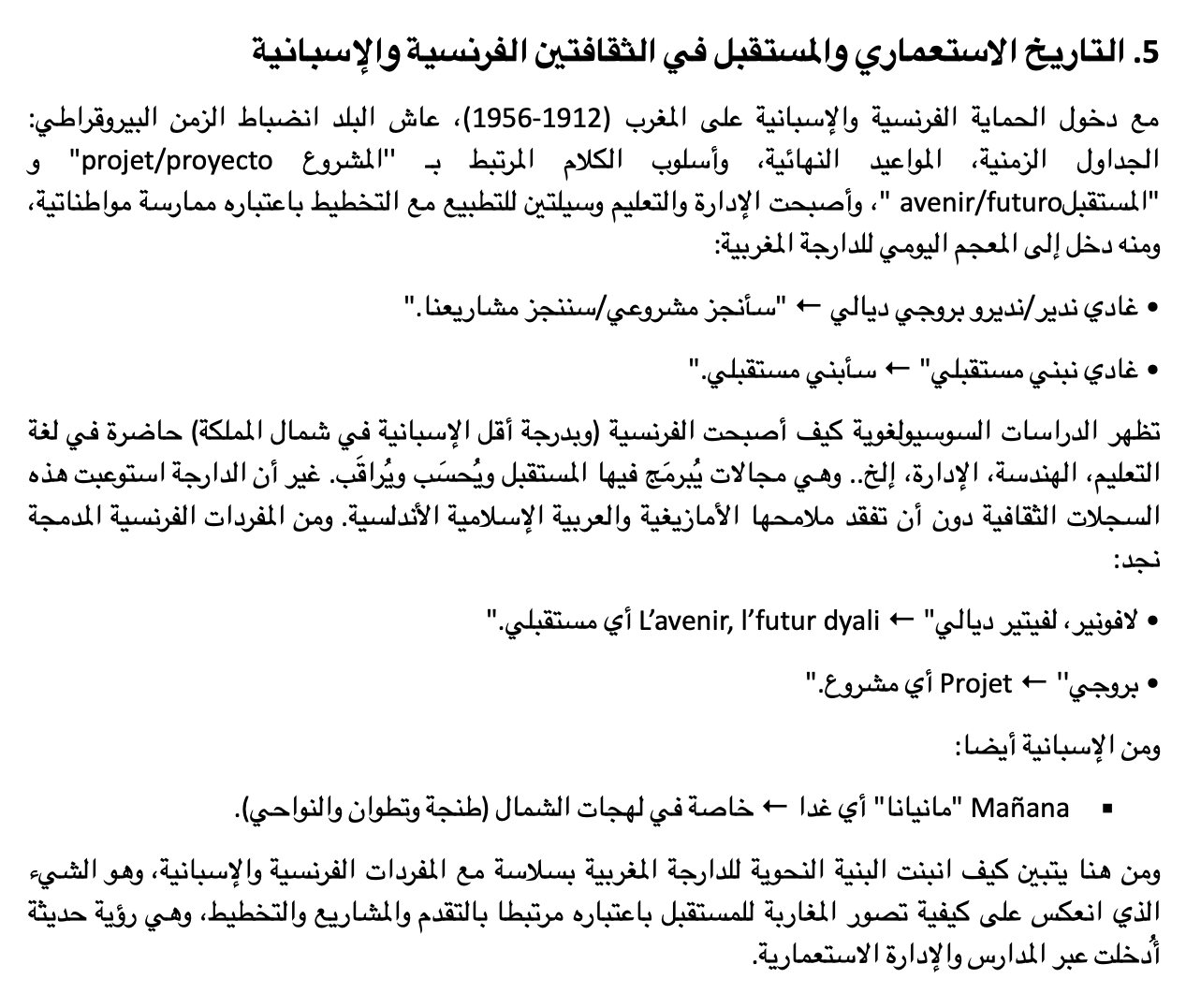
Colonial rule (1912–1956) introduced new temporal regimes centered on planning, projects, and deadlines. French and Spanish administrations normalized the idea of the future as something to be constructed through education, bureaucracy, and economic development.
Darija absorbed this logic linguistically:
- proʒi — “project”
- l-avenir / l-futur dyali — “my future”
- ghadi nbni mustaqbali — “I will build my future”
Here, Darija grammar seamlessly integrates borrowed vocabulary, allowing modern planning to coexist with Amazigh cyclical time and Islamic ethical restraint.
Globalization has further expanded this repertoire. English increasingly appears in youth discourse, business, and digital culture. However, even in globalized spaces, InshāʾAllāh often closes future statements, anchoring aspiration within local moral frameworks.
- ʿndi dream, ghadi nḥaqqo InshāʾAllāh — “I have a dream I will achieve, God willing”
Conclusion
Moroccan Darija encodes a polytemporal conception of the future, shaped by Amazigh recurrence, Islamic theology, Arabic grammar, colonial modernity, and global ambition. Time is not experienced along a single axis, but through overlapping rhythms: slow time (seasons and rituals), fast time (deadlines and migration), and sacred time (Ramadan, Mawlid).Linguistic practices such as ghadi, InshāʾAllāh, and fiha khīr mediate between intention and uncertainty, agency and humility. In Darija, the future is both approached and entrusted, planned and released. It is not merely awaited, but navigated—through a language that balances movement with patience, aspiration with trust, and human effort with divine will.
Original Language