
Research
This interview is part of a broader editorial project by Imminent, featuring conversations with expert professionals collaborating on Experience AI — which begins when machines learn and interact with the real world in real time — within the DVPS project.
DVPS is among the most ambitious projects funded by the European Union in the field of artificial intelligence, backed by an initial investment of €29 million. It brings together 20 organizations from 9 countries to shape the next frontier of AI — one rooted in the interaction of machines with the real world. Building on the success of large language models, DVPS explores the future of AI through multimodal foundation models. Unlike current systems, which learn from representations of the world through text, images, and video, these next-generation models are designed to acquire real-time empirical knowledge via direct interaction with the physical world. By integrating linguistic, visual, and sensor data, they develop a deeper contextual awareness, enhancing human capabilities in situations where trust, precision, and adaptability are critical. The overall initiative is led by Translated, which coordinates the project’s vision and implementation. The team brings together 70 of Europe’s leading AI scientists. The potential applications span across several domains, including language, healthcare and environment.
Marek Kasztelnik and Szymon Mazurek have joined the DVPS project, representing the Academic Computer Center CYFRONET AGH, the longest-operating and one of the largest supercomputing and networking centers in Poland.
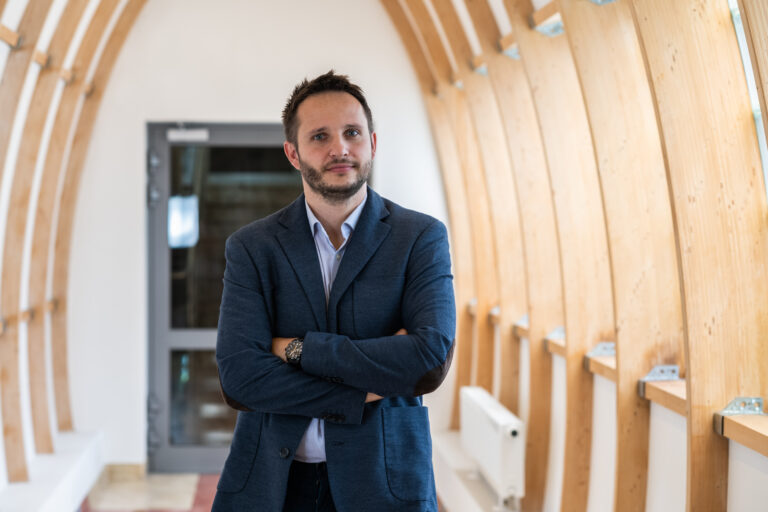
Marek Kasztelnik
AI/HPC Project & Initiatives Lead • Solutions Architect • Team Leader at ACK Cyfronet AGH
He specializes in developing solutions that enable the deployment of scientific applications on distributed HPC resources and in cloud infrastructures. He serves as Cyfronet’s project manager for research and implementation projects in the fields of computational medicine (including Gemini) and artificial intelligence (Meetween, DVPS). Coordinator of Gaia AI Factory. Creator of the Model Execution Environment – a pipeline-based data processing system for patient simulations, integrated with the Helios, Ares, and Athena supercomputers. Architect and lead developer of the first version of the EOSC Marketplace and the PLGrid grant system. Author of over 50 publications and presentations on e-science, personalized medicine, and HPC.

Szymon Mazurek
Deep learning Researcher & Engineer
Szymon Mazurek is a Deep Learning Engineer specializing in vision and perception, with expertise spanning the full AI R and D lifecycle, from research and prototyping to large-scale model training and deployment. His work bridges industry and academia, combining applied AI engineering with PhD research on Spiking Neural Networks for efficient Edge AI. His experience includes HPC, MLOps, performance optimization, and software engineering, alongside teaching and workshops that translate cutting-edge AI research into practical, real-world applications.
Cyfronet is one of Poland’s leading supercomputing centers. For those unfamiliar with the term, what does it actually mean?
Concretely, it means providing the infrastructure that an entire country’s research depends on. We maintain the machines and the software, ensuring the whole system operates efficiently—but just as importantly, we help researchers understand how to use that infrastructure for their own scientific work.
In practice, that means more than 100 people working across different layers of the organization: the physical infrastructure, including cooling and power; the hardware itself, which requires constant maintenance; the software stack; and specialists who work directly with researchers to optimize experiments, port applications, and solve problems that would otherwise remain unsolved. There’s no such thing as a typical day because the range of applications running on our systems is incredibly diverse.
This wasn’t always the case. We’ve been active for more than 50 years, and for a long time, we were Poland’s only source of large-scale computing. Anyone who needed to run demanding calculations came to us. Over the years, that role evolved. We expanded access to computing resources across the country and eventually helped build the PLGrid Infrastructure, connecting HPC centers throughout Poland. Today, access means much more than raw computing power—it also means storage, software services, and the expertise of the people who build and operate distributed computing infrastructure.
The work our users bring to us has evolved as well. Right now, in the age of AI, GPU-intensive applications dominate demand. That shift is also reflected in how we are organized internally. Different scientific domains pose different computational challenges, which is why we rely on specialists with a wide range of expertise. No single person can carry the weight of the entire scientific community’s needs.
Some of that expertise is deeply connected to specific research domains, from personalized medicine to Earth observation. Increasingly, it also includes LLMs. We have a dedicated team developing Poland’s largest large language models, Bielik and PLLuM, and Bielik is already performing competitively against leading European models.
Recently you ran your first multi-GPU test. What is a GPU test in practical terms, and was the performance promising?
Before you can push infrastructure to its limits, you need to know where those limits are. That was the premise behind these initial multi-GPU tests, which we ran across several clusters we have access to. Helios is the system we know best: It’s our own server, so we understand its network architecture and the constraints we’re likely to encounter. But we also ran experiments on MareNostrum and Leonardo, and we’re looking at extending this to LUMI and other European clusters down the line.
The early results are promising. Adding nodes to a training run produces a measurable performance boost—that much is clear. Where exactly the ceiling is, though, is harder to say. January’s tests were a starting point, not a conclusion. Different training runs have different characteristics, and we’ll need dedicated experiments tied to specific model training to get real answers.
What these tests also highlight is something important about scale. Distributed AI training isn’t just about the GPU. Single-chip performance is what vendors present in their white papers: the theoretical limit. But once you scale across multiple GPUs spread over multiple compute nodes, you start running into a completely different set of challenges. Networking becomes a bottleneck, and that bottleneck depends on the platform, the cluster, the model architecture, and how the model itself is distributed across nodes.
Running across different systems also allows us to experiment with different training-distribution technologies. One direction we’re exploring is containerization—packaging a training run so it can move between sites. The differences between clusters remain a challenge, but the approach is promising.
DISTRIBUTED AI TRAINING
Distributed AI training is the practice of spreading the computational workload of training a machine learning model across many processors, typically GPUs, spanning multiple compute nodes and, increasingly, multiple computing centers. The need for this paradigm arises from the scale of modern foundation models, whose parameter counts and training datasets have long outgrown the memory and processing capacity of any single device, and often of any single center’s infrastructure. Distribution is achieved through complementary strategies: data parallelism, where identical copies of the model train on different slices of the data and periodically synchronize their updates; model parallelism, where a model too large for one device is partitioned across several; and pipeline parallelism, where different layers are assigned to different devices and processed in assembly-line fashion. Large-scale runs typically combine all three. In principle, adding hardware accelerates training. In practice, however, the scalability gains are bounded by communication overhead and risks of hardware failures interrupting a run lasting weeks. Synchronizing gradients across thousands of devices places enormous demands on the interconnecting network, which often becomes the true bottleneck rather than raw chip performance. The severity of this networking bottleneck depends on the cluster, the model architecture, and how the model is sharded across nodes. Scaling beyond a single center introduces a further layer of complexity: every HPC facility has its own hardware, software stack, and operating policies, making training environments difficult to reproduce from one machine to the next. A key enabling technology here is containerization: the packaging of a training workload together with all its software dependencies into a portable, self-contained “container” that runs consistently across heterogeneous systems. Containers allow researchers to orchestrate experiments across geographically distributed clusters, without rebuilding their environment for each machine separately. This effectively turns a patchwork of independent supercomputers into usable, aggregate capacity. Distributed training underpins virtually all of today’s large language and multimodal models, and is equally indispensable in scientific domains such as climate simulation, genomics, and drug discovery.
And now you’re part of the DVPS project. What is your exact role in the project, and what changes in practical terms when supporting next-generation, multimodal models?
At its core, our role in DVPS is to provide the computing infrastructure, making sure researchers have the resources to actually run their experiments. That means provisioning the resources available within Cyfronet, but also supporting the consortium in securing EU HPC grants, given the scale of DVPS and the range of modalities and domain applications it’s trying to serve. These are foundation models, and training them means pre-training on massive amounts of data across a wide range of tasks. No single center’s infrastructure is enough for that. We need access to resources across Europe.
However, access alone isn’t the hard part. Every machine is different, and every center has its own operating policies. They’re broadly similar, but the differences are real—in the hardware, in the software stack, and in the way systems are managed. In fact, a significant part of our role is helping researchers move between centers and get the most out of each machine once they’re there.
That kind of mobility doesn’t happen without tooling. Beyond user support, we’re also building technology for the project: a toolset that tracks detailed information about training runs as they happen, including performance metrics and runtime statistics, and stores it centrally so the research team can monitor experiments at any point and decide what to do next.
DVPS brings together 20 partners across nine countries. What are the concrete challenges in coordinating compute, storage, and networking across multiple countries and institutions?
Coordinating a distributed research team is something we’ve been doing for over a decade. The PLGrid Infrastructure was built precisely for this. Bringing new users on board and giving them access to supercomputers and storage is straightforward. We already have the tools, the user portal, and the mechanisms to assign users to specific groups and computing grants. On that front, DVPS isn’t uncharted territory for us.
The real challenge is elsewhere. The scale of the project and the diversity of entities it brings together means that consortium members arrive with very different levels of familiarity with large-scale infrastructure, and that gap matters.
Moving massive amounts of data, centralizing storage, porting environments: these are solvable problems. What requires more sustained effort is the human side. You cannot, and should not, expect every researcher running calculations on an HPC system to have deep expertise in operating one. So our role extends beyond technical support. We also help educate users, establish practical procedures and guidelines, and show researchers how to migrate their workloads and make effective use of each system.
That work doesn’t happen in isolation. What we’re building within DVPS is also part of a broader European ecosystem. Projects like Epicure are creating support teams across different clusters to help onboard applications, while the AI Factories Initiative goes a step further by fostering the exchange of knowledge not only about individual systems, but also about how to operate them and deliver more unified services across European supercomputing centers.
What has coordinating infrastructure across multiple countries taught you about European scientific collaboration?
In Europe, we try not to build this kind of infrastructure in silos. We share knowledge, organize joint training for users across projects, and exchange experience on everything from infrastructure optimization to the workloads running on our clusters. That collaboration extends across HPC centers themselves, helping create a distributed environment that can be shared across the continent.
What we have today—not just what we hope to build in the future—is already substantial. Initiatives like EuroHPC and the AI Factories make that collaboration tangible. Researchers across Europe can apply for access to computing resources in different countries, and there’s a shared commitment to exchanging knowledge and computing power in order to build a stronger European AI ecosystem.
Furthermore, Europe already has world-leading expertise—not only in HPC, but also in domains such as healthcare, Earth observation, geointelligence, and large language models. We all know the success of Mistral in creating an open-source model that is competitive on the global stage. Of course, there are areas where other parts of the world are ahead. But there are also many where Europe has every reason to be confident.
There are technical challenges, of course. For instance, every center has its own policies, software environment, and operational procedures, and those differences have to be accommodated. But from our perspective, collaboration has rarely been the problem. We’ve consistently encountered helpful teams that were happy to work with us, solve problems, and help onboard both us and our users to different infrastructures. The differences are real, but our overall experience has been one of smooth and genuinely collaborative cooperation.
Beyond the technical side, do you think Europe has a distinctive approach in building AI?
Europe has set a clear political direction for the next ten to twenty years: bringing together countries, research organizations, and expertise to build a European AI ecosystem capable of competing globally. I believe that’s the right approach because we really don’t have any real alternative.
Any single European country, measured against the scale of the rest of the world, is simply too small. But if we join forces, exchange knowledge, and build together, we can create something genuinely innovative. Projects like DVPS are part of that vision. They establish networks between research organizations where we can share expertise, meet regularly, and identify new challenges to explore and solve together.
Some goals simply require a scale—and a diversity of competencies—that no single institution can provide on its own. Removing barriers to collaboration multiplies the impact of everyone’s work, because projects of this complexity can only succeed through the combined efforts of many experienced people.
There’s another aspect that I think is equally important. Europe is building AI on a different set of foundational principles. In many parts of the world, the priority is to gather as much data as possible and train models as quickly as possible. Here in Europe, we think carefully about legal access to data and about how to develop AI in an inclusive way. That may not always lead to the biggest models in the world, but it does lead to AI systems built on those principles. And I think that matters.
Looking ahead, how do you see the role of HPC centers evolving as AI continues to change?
I generally try to be cautious with predictions. Five years ago, very few people anticipated the emergence of LLMs and the impact they would have—not only on AI research, but on society, the economy, and the infrastructure investments we’re now seeing across the world. So any prediction should be taken with a grain of salt.
That said, if I had to point to a few technologies that could reshape how HPC centers operate in the future, these would be the ones. Quantum computing is certainly one of them, although I wouldn’t claim to be an expert in the field. The technology is advancing rapidly, and if we reach the point where quantum algorithms can be run effectively at scale, the impact will be significant.
The other area is neuromorphic computing, which feels much closer. The chips already exist, they’re developing quickly, and they’re already finding commercial applications. Europe is actually one of the key players here, with projects like SpiNNaker and BrainScaleS, as well as a growing number of companies developing neuromorphic hardware. This isn’t a technology we’re still waiting for—it’s already here, and it’s evolving rapidly.
At the same time, we’re seeing a broader shift in AI itself. Robotics and edge AI are progressing very quickly, with more and more intelligent applications running directly on power-constrained devices rather than in large data centers. If that trend continues, it will also change what we expect from HPC centers. In the future, they may provide not only traditional CPU and GPU resources, but also neuromorphic hardware, allowing researchers to develop and test solutions that can later be deployed at the edge. The same applies to quantum computing. Today these systems are still extremely complex and expensive, but if the technology matures and demand grows, HPC centers will have to think seriously about providing quantum resources as well.
Thinking toward 2028, when the project will end, what do you think will be the biggest impact and legacy of DVPS?
I believe the project’s main legacy will be a fundamental shift: We will be building, not consuming. We will know how to develop foundation models ourselves, and we’ll be able to share that knowledge across Europe.
The family of models developed through the project will be tremendously important—not only for European society, but also beyond. But just as important is the expertise we will have built along the way. We’ll have demonstrated that Europe has the skills, the talent, and the know-how to develop these technologies when they’re needed.
For me, that’s DVPS’s real legacy.