Research
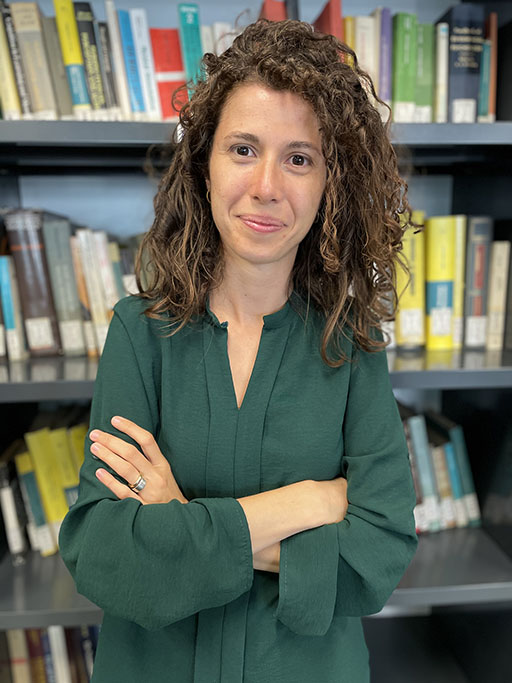
Martina Ardizzi
Associate Professor, Department of Medicine and Surgery – Unit of Neuroscience, University of Parma
Martina Ardizzi obtained her Master degree in Neurosciences and Neuropsychological Rehabilitation at the University of Bologna (Italy) in 2010. In 2014 she achieved her PhD in Neuroscience at the University of Parma, Italy, under the supervision of prof. Vittorio Gallese, studying the effect of childhood maltreatment on intersubjectivity development in Sierra Leone. At the moment, she is fixed-term researcher at the Department of Medicine and Surgery – Unit of Neuroscience of the University of Parma.
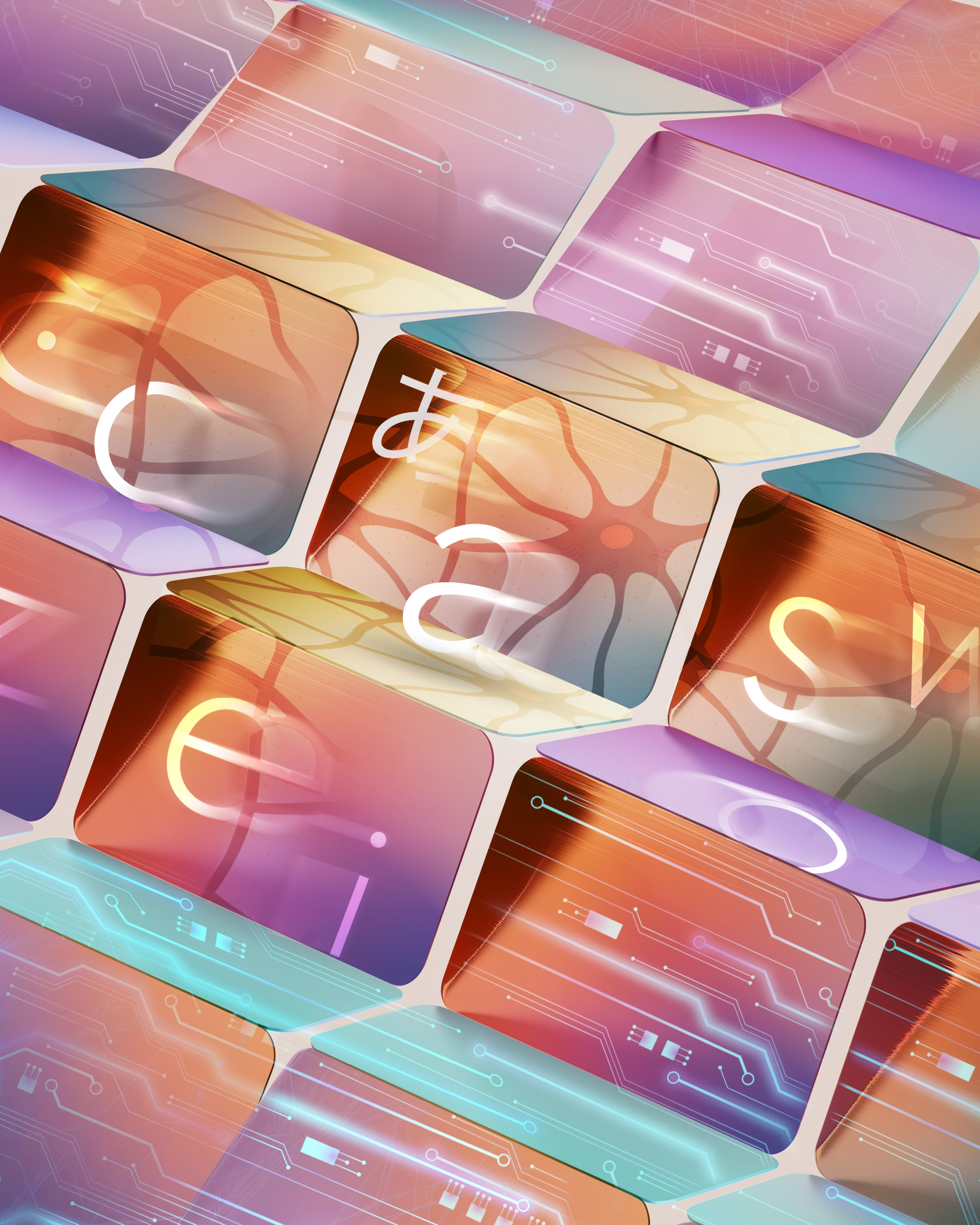
The Language You Knew Before You Were Born – October Issue
Long before you saw a face or drew a breath, you were already listening.
By the third trimester, hearing works. Sound reaches the fetus from around 24 to 28 weeks of gestation, but it does not arrive clean. The womb is a warm, fluid-filled chamber, and it behaves like a low-pass filter, letting the low frequencies through and muffling everything above roughly 600 Hz. Consonants, which live higher up, are smeared away. What survives is the melody and rhythm of speech, its prosody. The first thing a human brain ever registers about language is not words but their shape in time.
There is something worth pausing on here. Of all the sounds available to a developing brain, the heartbeat, the churn of digestion, the muffled noise of a body at work, it is speech that leaves the deepest mark. The fetal brain does not merely hear language passing through; it tunes toward it, sorting this particular stream of sound out from the rest and preparing to take it up. Long before language is useful, before it names anything or asks for anything, the brain treats it as something to be assimilated. Whatever else the human infant is built to do, it arrives already oriented toward the speech of others.
That orientation leaves a trace, and for a long time the trace could only be inferred, never seen. The problem was how to ask a newborn what it knew, and the answer came from a beautifully simple idea: let the baby tell you with a pacifier. Wire the pacifier to record the rhythm of sucking, and make the sound the infant hears depend on how it sucks, and a few hours-old human will happily change its own behavior to summon back a sound it prefers. What newborns chose to summon, again and again, turned out to be the familiar. They worked to hear their mother’s voice over a stranger’s. They recognized the cadence of a story their mother had read aloud in the last weeks of pregnancy, though its meaning was still years beyond them. Offered their native language against a foreign one of a different rhythm, they pulled for the native; offered the vowels of that language against foreign vowels, newborns on two continents treated them differently. Across four decades of these experiments a single conclusion kept tightening: the newborn is not a blank listener meeting language for the first time, but a returning one, already carrying the shape of a particular speech it met before birth. Prosody first, then the finer grain of the sounds themselves, all before the world had fully come into focus.
What behavior implied, the brain has now confirmed. In 2023, Mariani, Gervain and colleagues recorded the electrical activity of newborns before and after playing them speech. The measure they used captures how long the brain sustains its own patterns, how strongly each moment of activity carries over into the next. After hearing speech, that persistence increased, the brain lingering longer in the states the sound had set going, a physical signature of experience being retained rather than merely registered. The effect was strongest for the language the infant had heard in the womb, and it appeared in the frequency band tied to the rhythm of syllables, exactly the part of speech the prenatal signal preserves. Newer imaging work by René, Gallagher and colleagues has since gone further. By controlling what fetuses heard in the last weeks before birth, they found that a newborn’s brain responds to a foreign language it was exposed to in the womb much as it responds to its own.
That last result points to something easy to miss. The brain is not waiting for a specific language. Nothing about it is set for Italian, or French, or Swahili. What it is prepared for is whatever prosody actually reached it, whichever language happened to be spoken around the body that carried it. In René and Gallagher’s study the imprinted language was one the family did not even speak, piped in for the experiment, and the brain took it up all the same. The phrase mother tongue quietly suggests inheritance, something passed down by blood. Biology says something plainer and, to my mind, more interesting: your first language is simply the one you were bathed in. Had you spent those months inside a different life, a different language would have become the one your brain leaned toward, with no less ease and no more effort.
None of this means a fetus learns a language. There are no words in the womb, no grammar, no meaning, and the researchers themselves are careful on this point. What the prenatal brain takes in is the music of speech, the rhythmic fingerprint of the particular language it happened to hear. The right word is not learning but tuning, the brain arriving already leaning toward the sounds it will spend a lifetime using.
Step back and the picture is striking. A human being begins acquiring language from inside a body, through a medium that degrades the signal, before it has any concept of what language is for. The input is partial, low-fidelity, stripped of its consonants. And it is enough. By the time a newborn opens its eyes, its brain is already biased toward one corner of the space of all possible human languages, the corner its particular world happened to occupy.
This is worth holding onto in a moment when we are surrounded by systems that learn language too. A model is trained on a vast, clean corpus, every sentence intact, every word spelled out, more text than a person could read in ten thousand lifetimes. A human brain starts with almost the opposite: a few months of muffled prosody heard through fluid, no words at all, inside a body that is still being built. Two radically different routes to what looks, from the outside, like the same capacity. Understanding the first is not a detour on the way to understanding the second. It may be the sharpest comparison we have.
We knew the melody before we knew the words. That is where language begins.
Welcome to Wetware. Let’s look inside the one that was here first.
References
DeCasper & Fifer (1980), Science; DeCasper & Spence (1986), Infant Behavior and Development; Moon, Cooper & Fifer (1993), Infant Behavior and Development; Moon, Lagercrantz & Kuhl (2013), Acta Paediatrica; Mariani et al. (2023), Science Advances; René et al. (2025), Communications Biology.