Language
This is the full version of the Off the Charts column published in the October 2026 issue of Imminent Readings.
Can you think of yourself as part of one country—one kingdom—if you don’t even share a language with the people who supposedly share it with you? And if it isn’t the language, what’s the secret ingredient that makes a patchwork of regions feel like one nation?
Two weeks ago in Cardiff, the first ministers of Scotland, Wales, and Northern Ireland signed a joint declaration stating that “Westminster’s time is coming to an end” and that each of their nations has the right to decide its own future. It’s the first time in UK history that all three have been led by governments that want out. Prime Minister Andy Burnham says a new Scottish independence referendum remains off limits for now, arguing that there is no clear public consensus for one; he has likewise said there is no present evidence of a majority in Northern Ireland for leaving the UK.
Among the many pieces published on the topic, these are the ones actually worth reading:
- AOL on why the three nations are converging politically despite very different timelines, aims, and constitutional routes
- Modern Diplomacy on why the Cardiff Agreement is a political pressure tactic, not a legal breakthrough
- Diplomacy & Law on the very different legal routes—if any—available to each region
- Council on Foreign Relations on how self-determination helped dismantle empires—and why it is so much harder to turn into statehood today
It’s tempting to read this as another round of a very old, very British argument. But underneath it sits a question every plural country eventually has to face: What actually holds people together once you take away the flag and the passport? In the UK’s case, one answer keeps resurfacing beneath every constitutional headline: self-determination and language.
The Idea that Keeps Redrawing the Map
“Self-determination” was the phrase all three sides in Cardiff kept repeating. It sounds bureaucratic, but it isn’t. It actually may be the single idea that has reshaped the modern world more than any war. A little over a century ago, empires controlled roughly 60% of the planet; today there are nearly two hundred sovereign states: four times as many as in 1920. Almost entirely because the world accepted, in principle, that a people gets to decide its own fate.
That principle became one of the load-bearing values of the post-war order itself: written into the UN Charter in 1945, it’s the reason decolonization could happen as a negotiated transfer of power rather than as one long war fought island by island, colony by colony. It’s also why the same idea keeps resurfacing each time a new state is born: East Timor in 2002, Montenegro in 2006, South Sudan in 2011.
But this principle was often applied to a map that had already been drawn, and not by the people living and governing those territories. Self-determination gave people the right to govern themselves. It never asked whether the borders they’d been handed had anything to do with who they actually were, linguistically or culturally, in the first place.
In fact, most of those new borders followed the logic of the empires that had drawn them in the first place—administrative lines, spheres of influence, and trade routes—more than the cultures and languages of the people who actually lived inside them. Where the map failed, and often stirred conflict within its own lines, language kept signaling what a territory actually wanted. Decades later, it remains one of the clearest litmus tests of where that fragmentation really runs.
Which is exactly where the UK’s own case starts to make sense.
A Difficult Linguistic Framework
Britain’s own borders are a case in point. The line separating England from Wales and Scotland predates most of Europe’s modern nation-states, yet the languages spoken on either side of it were never folded into a single “British” tongue the way the political map might suggest.
Scots, Welsh, Gaelic, and Irish didn’t survive by accident, and that’s unusual: Most of Western Europe flattened its regional languages through centuries of compulsory schooling in the language of the capital, such as with Occitan in France or Low German in Germany. Britain never quite managed that, largely for reasons of power rather than tolerance: These language communities sat across islands and highlands that were harder to police from London, and each nation retained enough of its own institutions—Scotland a separate legal system, Wales its own church after 1920—for those languages to keep a place to live in. By the time devolution arrived in 1998, it wasn’t an administrative inconvenience, but the outline of a fracture that had never fully closed.
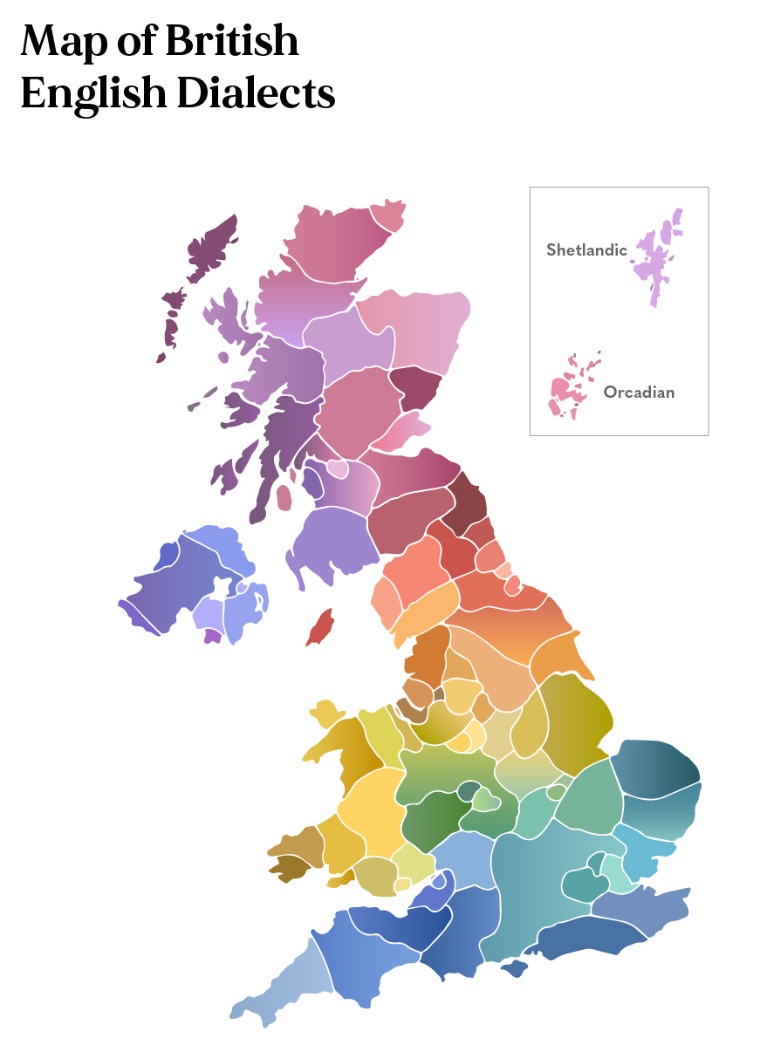
Source: Starkey Comics
Look at a linguistic map of the isles and “united” starts to look like a hope rather than a fact. Scots remains part of everyday speech for millions of people across Scotland. Welsh, once discouraged in many schools, is now protected and promoted by law. The 2021 census recorded 538,300 speakers in Wales, or 17.8% of the population, down from 19.0% in 2011. Scottish Gaelic remains concentrated in the Outer Hebrides; in the 2022 census, 130,161 people reported some Gaelic skills, while about 69,700 said they could speak it. In Northern Ireland, only in 2022 did Westminster give statutory recognition to the status of Irish, creating an Irish Language Commissioner and duties for public authorities.
None of this was accidental: Deciding which language got taught, printed, and spoken in Parliament has long been a way of deciding who counted as fully part of the nation.
A Force with Global Reach
The UK isn’t unusual here—it’s one entry in a much longer pattern. In Catalonia, decades in which speaking Catalan in public was a political act turned the language into the backbone of the independence movement. In Ukraine, defending the language has become inseparable from defending the right to exist as something other than a neighbor’s province. Estonia, Latvia, and Lithuania sang their way toward leaving the Soviet Union, quite literally, through festivals of banned native songs which were too crowded to shut down.
Language doesn’t only divide, though: Indonesia held together thousands of islands by building its independence movement around Bahasa, a language that belonged to no single dominant group and so threatened no one. What changes from case to case isn’t whether a place is multilingual, nearly everywhere is, but whether that mix is treated as something everyone owns together, or as proof that someone in the room was never quite from here.
Three decades of devolution gave Scotland, Wales, and Northern Ireland their own parliaments without ever settling what, besides law, was meant to hold them to London. A memorandum signed in Cardiff won’t undo three centuries of union, and the legal cards are still stacked entirely on Westminster’s side. But no law has ever decided what a nation feels like from the inside. Language does that, quietly, every day, whether or not anyone in Westminster is still listening.