Africa
To which language should you translate to localize in Senegal?
What we know from our community
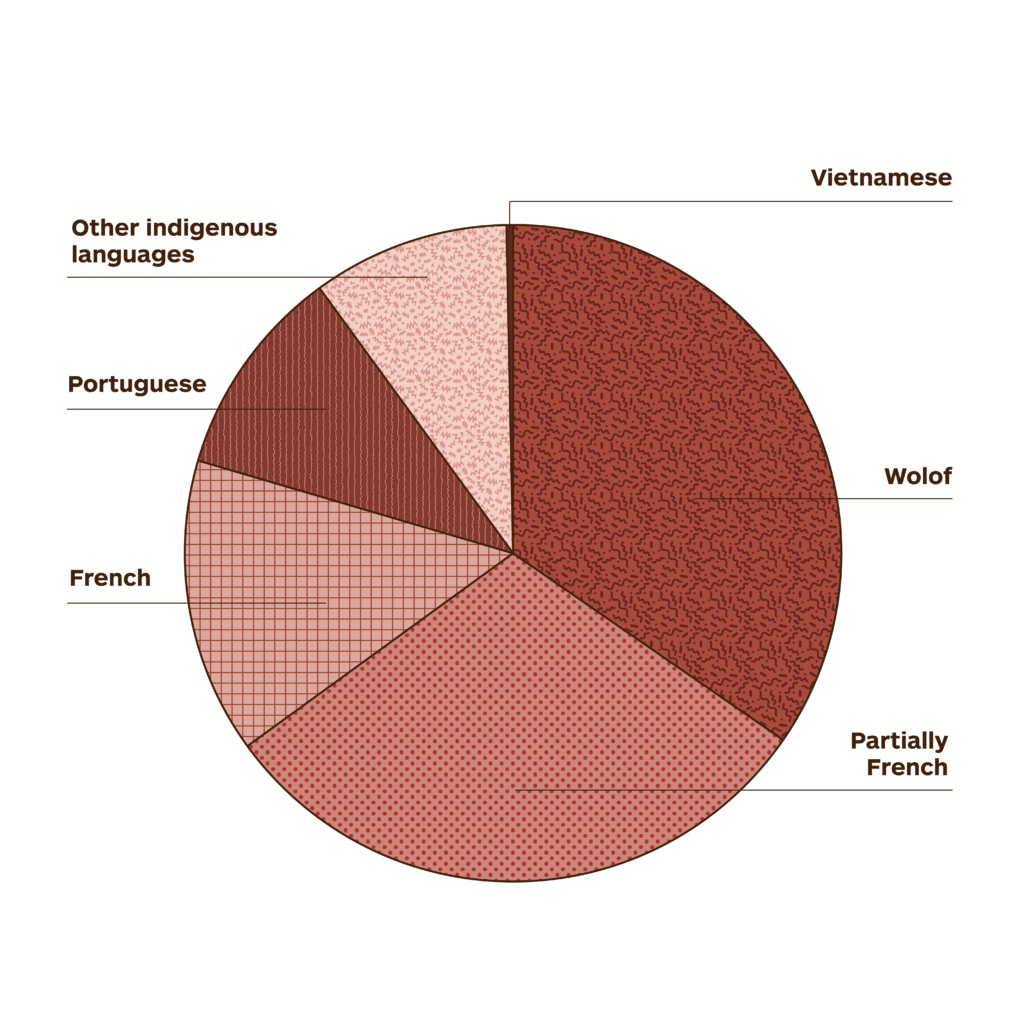
French is the official language but is understood by about 15–20% of all males and about 1–2% of all women. While French may be the language of political and economic power in Senegal, Wolof is the language of social power and community.
LANGUAGE INSIGHT
Official language
French (1.4%; 253k)
Actual languages
Wolof (43.1%; 7.79 mln), Fulfulde (20.7%; 3.74 mln), Serer (12.5%; 2.25 mln), Bambara (10.3%; 1.86 mln), Diola (5%; 903k), Maninka (3.8%; 686k), French (1.4%; 253k), Soninke (1.3%; 235k), other (1.9%; 343k)
What the top 150 best localized websites in the world do in Senegal
(Top 150 websites listed in the Global by Design ranking – published annually by Byte Level Research, this report provides a list of globally localized websites, showcasing best practices and emerging trends in their globalization)
- 29/150 localize by translating into French
- 2/150 localize by translating into Arabic
- 1/150 localizes by translating into both French and Arabic
- 1/150 localizes by translating into both French and Portuguese
- 1/150 localizes by translating into French, Wolof, Fulfulde, Serer, Bambara, Diola and Soninke
-
 3M
3M
-
ABB
-
Accenture
-
Adidas
-
Adobe
-
Airbnb
-
Aldi
-
Amazon
-
American Airlines
-
American Express
-
Apple
-
Audi
-
Autodesk
-
Avis
-
Bayer
-
BMW
-
Booking.com
-
Bosch
-
British Airways
-
Bumble
-
Burberry
-
BYD
-
Canon
-
Capgemini
-
Cartier
-
Caterpillar
-
Chevrolet
-
Cisco Systems
-
Citibank
-
Coca-Cola
-
Costco
-
Dell
-
Deloitte
-
Delta
-
DHL
-
Disney+
-
Dyson
-
eBay
-
Eli Lilly
-
Emirates
-
Ernst & Young
-
Facebook
-
FedEx
-
Ford
-
Four Seasons
-
Fujifilm
-
GE
-
Gillette
-
GoDaddy
-
Google
-
Gucci
-
Haier
-
Heineken
-
Hermès
-
Hertz
-
Hilton
-
Hisense
-
Hitachi
-
Honda
-
Hotels.com
-
HP
-
HP Enterprise
-
HSBC
-
Huawei
-
Hyatt
-
Hyundai
-
IBM
-
IKEA
-
Intel
-
InterContinental Hotels
-
J&J
-
Jack Daniel's
-
Jehovah’s Witnesses
-
John Deere
-
Kellogg's
-
Kia
-
KPMG
-
L'Oréal
-
Land Rover
-
LEGO
-
Lenovo
-
Lexus
-
LG
-
Louis Vuitton
-
Lululemon
-
LUSH
-
Marriott
-
MasterCard
-
McDonald's
-
Mercedes-Benz
-
Merck
-
Microsoft
-
Mitsubishi Electric
-
Nestlé
-
Netflix
-
Nike
-
Nikon
-
Nintendo
-
Nio
-
Nissan
-
NIVEA
-
Oracle
-
Pampers
-
Panasonic
-
PayPal
-
Pepsi
-
Pfizer
-
Philips
-
Pitney Bowes
-
Porsche
-
Procter & Gamble
-
PWC
-
Revolut
-
Rolex
-
Royal Caribbean
-
Salesforce
-
Samsung
-
Sanofi
-
SAP
-
Sephora
-
Shopify
-
Siemens
-
Sony
-
Spotify
-
Starbucks
-
Steelcase
-
Stripe
-
Subaru
-
Tesla
-
The Church of Jesus Christ of Latter-day Saints
-
Tiffany
-
Tinder
-
Toshiba
-
Toyota
-
TripAdvisor
-
Uber
-
United Airlines
-
UPS
-
Visa
-
Volkswagen
-
Volvo Cars
-
Vrbo
-
Walmart
-
Western Union
-
Wikipedia
-
Wise
-
WordPress
-
Workday
-
Xerox
-
Xiaomi (Mi)
-
Zara
-
Zoom


If you need others information, below you can find a selection of economic/social/cultural data
Overview
Language
Official language
French
T-index
0.023%
T-Index ranks countries according to their potential for online sales.
Other languages
Wolof (80%), Balanta-Ganja, Hassaniya Arabic, Jola-Fonyi, Mandinka, Mandjak, Mankanya, Noon (Serer-Noon), Pulaar, Serer, Soninke.
English
Very low proficiency (EF) – 102 of 116 countries/regions in the world- 18/24 position in Africa.
Demography
Capital: Dakar
Currency: West African CFA franc
Population: 18.07 mln
Population density: 92/km2
Economy
GDP: 30.85 billion USD (2023)
GDP per capita: 1,745.97 USD (2023)
Exports: $5.72 billion (2023)
Statistics
Internet users: 60% penetration, 10.79 million
Unemployment rate: 2.8% (2023)
Urbanisation: 50% (2023)
Literacy: 58% (2022)
Conventions
Numbering system
Arabic numbers and comma as decimal separator
Date format: dd – mm – yyyy
Time: 24h time system
Country code: 00221
Language data sources: Worldatlas/Britannica//EF/Wikipedia; Demography data sources: IMF/Worldometers; Conventions data source: Wikipedia; Economy data sources: WTO/OEC/CIA/Esomar/Datareportal; Statistics data sources: Datareportal/WorldBank/UN/UNESCO/CEIC/IMF/Culturalatlas/Commisceoglobal
Facts and data
Economy
Imports
$15.1 billion (2023). Refined Petroleum ($2.07B), Crude Petroleum ($951M), Rice ($612M), Wheat ($340M), and Cars ($290M), importing mostly from China ($2.93B), France ($1.4B), Nigeria ($1.02B), India ($1.01B), and Russia ($828M).
In 2023, Senegal was the world’s biggest importer of Processed Synthetic Staple Fibers ($38.9M).
Financial inclusion factors (over 15 years of age)
• 28.1% have an account with a financial institution
• 4.8% have a credit card
• 44.9% have a mobile money account
• 4.1% make online purchases
Ease of doing business
Ease of conducting business is medium (59.3 out of 100) 16th out of 48 Sub-Saharan African countries 123rd worldwide out of 190 countries (2024, World Bank).
Exports
$5.25 billion (2021). Gold ($1.07B), Refined Petroleum ($844M), Phosphoric Acid ($497M), Non-fillet Frozen Fish ($284M), and Cement ($178M), exporting mostly to Mali ($1.22B), India ($681M), Switzerland ($625M), China ($310M), and United Arab Emirates ($251M).
In 2023, Senegal was the world’s biggest exporter of Processed Synthetic Staple Fibers ($41M).
Economic freedom
‘Mostly not free’ (55.4 out of 100) ranked 16th out of 47 Sub-Saharan African countries and ranked 109th out of 184 countries worldwide (2024, Heritage Foundation and Wall Street Journal).
Global Innovation Index
Ranked 5th out of 28 Sub-Saharan African countries, and 93rd out of 132 worldwide.
The Global Innovation Index captures the innovation
ecosystem performance of 132 economies and tracks the most recent global innovation trends.
Economy data sources: WTO/OEC/CIA/Esomar/Datareportal
Service Imports (2018)
Service Exports (2018)
Source: OEC
Trade balance of goods from 2012 to 2022
Source: Statista
Historical Data Trade Imports
The following section uses historical trade data imports from partners of Senegal.
Historical Data Trade Exports
The following section uses historical trade data exports from partners of Senegal.
Source: OEC
The Top Export Opportunities for Senegal by Relatedness
Relatedness measures the distance between a country's current exports and each product by showing only products that Senegal is not specialized in.
Senegal's Most Complex Exports
The Product Complexity Index (PCI) measures the knowledge intensity of a product by considering the knowledge intensity of its exporters.
Source: OEC
Senegal's Most Specialized Products
Specialization is measured using Revealed Comparative Advantage (RCA), an index that takes the ratio between Senegal observed and expected exports in each product.
Source: OEC
Market Growth Imports (2018)
This score represents the likelihood that the given country will start importing that product in the next few years. It forecasts the opening of a new specific market.
Market Growth Exports (2018)
This score represents the likelihood that the given country will start exporting that product in the next few years. It forecasts the opening of a new specific market.
Source: OEC
Foreign direct investment, net inflows (% of GDP)
Source: WorldBank

T-index
Reach most of the online purchasing power
T-Index ranks countries according to their potential for online sales. It estimates the market share of each country in relation to global e-commerce.
Try it nowMedia
Media language French
Information channels
Senegal has traditionally had one of the most unrestricted and diverse media scenes in the region. The constitution guarantees freedom of information and abuses against journalists are relatively infrequent, says Reporters Without Borders. But some subjects remain off limits for reporters. There are around 20 TV stations. Radio is an influential medium. Commercial and community stations have mushroomed. There are nearly 30 daily newspapers. BBC World Service (105.6 MHz) and Radio France Internationale are available on FM in Dakar. The online news media are highly-developed and include internet-based TV outlets.
The press
Le Soleil – state-owned daily
Sud Quotidien – private daily
Le Quotidien – private daily
L’Observateur – private daily
Wal Fadjri L’Aurore – private daily
Television
Radiodiffusion Television Senegalaise (RTS) – state-run, operates RTS1 and RTS2
TFM – private
2S TV – private
Radio
Radiodiffusion Television Senegalaise (RTS) – state-run, operates Chaine Nationale and Senegal Internationale, Dakar FM, regional services
Sud FM – private, in Dakar and other cities
Walf FM – operated by Groupe Wal Fadjri
Dunyaa FM – private
News agency
Agence de Presse Senegalaise – state-run
PANA – Dakar-based pan-African news agency
Media data source: BBC
Internet Data
Internet users
60% penetration, 10.79 million
Share of web traffic by device
78.37% mobile phones, 20.74% computers (laptops and desktops), 0.88% tablet devices, others 0.01%
Average speed of mobile Internet connection
27.16 Mbps
Average speed of fixed Internet connection
21.98 Mbps
Mobile connection as a percentage of total population: 121.8%
Percentage of mobile connections that are broadband (3G-5G): 87.8%
Most popular web search engines
Google (95.74%), Bing (3.88%), Yahoo! (0.21%), DuckDuckGo (0.05%), Ecosia (0.04%), other (0.09%).
Most used social media
Facebook (94.67%), Twitter (4.14%), Instagram (0.53%), Pinterest (0.29%), YouTube (0.28%), LinkedIn (0.04%), Reddit (0.03%), other (0.01%).
Internet data sources: Datareportal/Statcounter
Social statistics
Life expectancy
68 yrs (2022)
CO2 emissions
0.7 metric tons per capita
Corruption perceptions Index
Senegal scored 43 out of 100, ranked 72 out of 180 countries worldwide.
Current health expenditure
4.35% of GDP (2021)
Current education expenditure
88.6% of total expenditure in public institutions
World Happiness Index
Senegal ranked 103 out of 146 countries, with a score of 5.046.
Tertiary education in Senegal (gross enrolment ratio)
Tertiary education by sex (gross enrolment ratio)
Social statistics sources: WorldBank/UN/UNESCO/CEIC/IMF
Country Curiosities
Even if you’ve never studied Wolof, you might already be using words that come from it. Take “banana,” for example—before making its way into English through Spanish or Portuguese, it likely originated in Wolof. And it’s not alone. Words like “chigger,” “jive,” and “juke” may also trace their roots back to Wolof. While pinpointing exact linguistic origins is challenging, the similarities between these English terms and their Wolof counterparts are undeniable.
Additionally…
- 39 languages: French is official, Wolof is the most spoken, and 6 others hold national status.
- Senegal is known as the “Land of Teranga,” which means hospitality in Wolof.
- Ranked 6th in Africa for ease of doing business in 2023.
- It is one of the largest peanut exporters in the world.
- 97% of Senegalese are Muslim, with many learning Arabic for religious purposes.
- 72% of the 80% Wolof-speaking population use it for interethnic communication.
- Wolof can be written in Arabic-based (Wolofal) or Latin script.
- “Senegal” comes from the Wolof phrase ‘Sunuu Gaal,’ meaning ‘Our Boat.’
- Known as the Gateway to Africa, with the continent’s farthest western coastline.
The Data Factbook is a work in progress project. Our community is helping us to fill it up always with new and updated data. Your contribution is precious. If you want to help us, please write your advices at imminent@translated.com
Languages research
Areas where Wolof is spoken

Francophones and non francophones in Senegal

Languages spoken in Senegal
The geographical distribution of languages that you will find in the maps published in this section is a work in progress. Our community is helping us to fill it up with always new and updated data. Your contribution is precious. If you want to help us, please write to imminent.factbook@translated.com
Photo credit: IgorSPb, iStock