Language
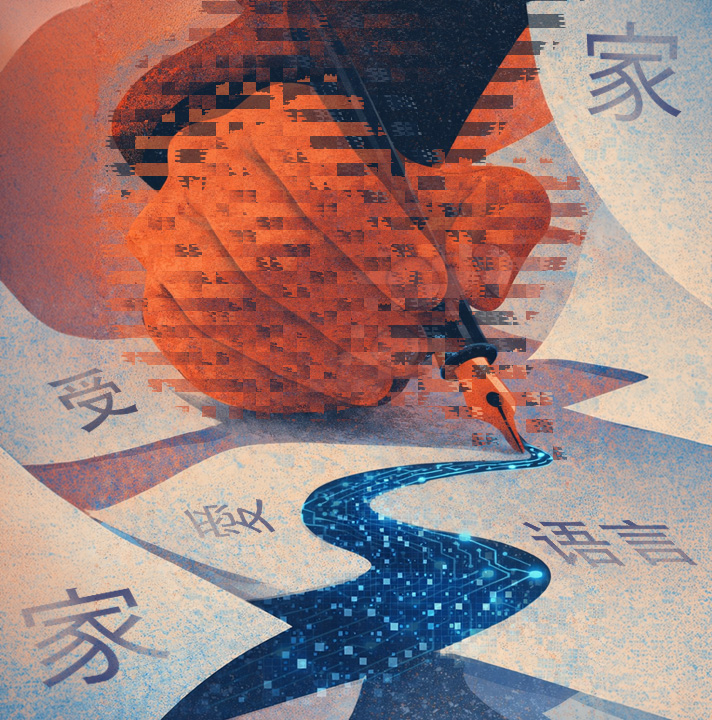
Character Amnesia refers to a phenomenon where individuals, despite being familiar with a character’s meaning and pronunciation, temporarily forget how to write it correctly. A survey of 2,517 participants conducted by the Social Survey Center of China Youth Daily found that 98.8% of respondents had experienced this phenomenon, and only 38.9% said they frequently write Chinese characters by hand. In this age of digitization, people can read and type Chinese fluently — yet the ability to handwrite characters is quietly fading.
Unlike in the past, our daily lives are now dominated by digital devices and electronic communication. The surging wave of digitization has not only brought convenience and enhanced efficiency to our lives, but has also transformed the way we interact with the world — particularly in China, which has embraced this shift proactively. In Chinese-speaking regions, pinyin (拼音) input systems on smartphones and computers allow users to type characters by selecting them from a list based on their pronunciation, reducing the need to recall the exact visual form or stroke order of each character. Advanced voice recognition and predictive text technologies further minimize manual writing, leading to a steady decline in engagement with the physical act of forming characters.
Yet Chinese characters are pictographs, and for Chinese people, writing is not merely about drawing symbols that carry meaning — it is a process of connecting with Chinese culture and history while reinforcing muscular memory through stroke practice.
Take 家 (home) as an example. The upper part of the character is 宀, symbolizing the roof of a dwelling. Inside sits 豕, representing a pig — an animal that, in ancient China, signified wealth and abundance within the household. As this etymology reveals, 家 has always been about protection and sufficient resources for the family. Another example is 愛 (love), composed of 心 (heart) and 受 (accept). In Chinese culture, love means accepting all aspects of a person — positive and negative alike — with an open heart.
If these symbols are reduced to digital icons or pinyin inputs, their cultural resonance may weaken, potentially diluting the uniqueness of Chinese civilization
This is why the decline in handwriting proficiency threatens to sever people from ancient Chinese wisdom. If these symbols are reduced to digital icons or pinyin inputs, their cultural resonance may weaken, potentially diluting the uniqueness of Chinese civilization. If society remains passive in the face of Character Amnesia, the losses will extend far beyond the visual forms of the characters themselves — people may find themselves struggling to construct sentences that truly convey the thoughts and emotions we wish to express.
For thousands of years, the act of writing Chinese characters has been revered as an art form: Chinese calligraphy. There is a growing need to leverage this time-honored tradition to inspire more people to learn, appreciate, and carry forward not only the legacy of Chinese characters, but the profound culture they embody.
In China, many strategies are already emerging to meet this challenge. Calligraphy clubs and classes are flourishing in schools, alongside competitions, grading exams, and after-school tutoring services. Technology, too, is proving to be an ally: an AI calligraphy coach made its debut at the 2022 Hangzhou Asian Games, offering precise guidance on stroke techniques and character structure. To date, the tool has supported students from calligraphy programs at more than 30 universities in their daily practice.
More broadly, technology is becoming a powerful instrument for cultural preservation. The China Pavilion at the Osaka Expo brings traditional Chinese aesthetics and new technologies into dialogue, enabling the dissemination of Chinese culture to reach wider audiences with greater resonance. Among the highlights were an AI-powered Monkey King avatar, interactive deep-sea projections, and the Walker C humanoid robot, which served as a guide through the exhibits. Beyond the Expo, digital storytelling is also playing a role: the renowned content creator Liziqi (李子柒), with over 28 million subscribers on YouTube, has brought Chinese cultural traditions to a global audience through her videos.
Technology is becoming a powerful instrument for cultural preservation
These initiatives are part of a broader national vision. The government has launched research and training programs for cultural inheritors — the total number of national-level representative inheritors of intangible cultural heritage has now reached 3,998 — and established clear guidelines prioritizing protection, rescue, rational use, and the promotion of inheritance and development.
A key policy document, “Opinions on Implementing the Project for the Inheritance and Development of China’s Excellent Traditional Culture,” further reinforces this direction. It calls for integrating traditional Chinese opera, calligraphy, refined arts, and traditional sports into school curricula, as well as strengthening Chinese cultural education across the teaching workforce with the goal of enhancing its overall quality.
While these measures address the challenge of Character Amnesia, some complex characters may inevitably fall out of frequent use, and the meanings of others may shift over time. This is not unprecedented: over more than four thousand years of history, the language has undergone continuous transformation, yet ancient wisdom has always found ways to survive. In this era of digitization, traditional knowledge and cultural heritage will continue to be upheld — through new and innovative means. Chinese culture has always been defined by its inclusivity. Its language may evolve, but it will not become obsolete.

Celia Gong
Chinese Linguist and Translator
Celia is a seasoned linguist with over a decade of expertise in Chinese and English language services. Based in Shanghai, China, she has dedicated her career to bridging linguistic and cultural gaps through translation, localization, and cross-cultural communication. With a deep understanding of the nuances of both languages, she has collaborated with global organizations, educational institutions, and marketing firms to deliver accurate and culturally resonant content.