Global Perspectives
Taysha
Texas began with a greeting. When the Spanish arrived, the Caddo came forward as friends and allies and used a single word for it: taysha. The Spanish heard Tejas, gave the name first to the people and then to the land, and in American mouths it eventually became Texas. In 1930 the state legislature chose “Friendship” as its official motto, partly in recognition of that origin (Texas Highways).
It is a telling choice for a place whose history has mostly been written at the edges of other people’s maps. Over two centuries, Texas was a Spanish province, part of Mexico, an independent republic, and finally an American state, and for much of that time more than one power claimed its borders and none fully controlled it. Lands like this rarely belong to a single people. They are crossed by soldiers and missionaries, ranchers and traders, families looking for land and workers looking for wages, and each new group arrives to find others already there.
Texan identity took shape in that crowd, less by replacing those who came before than by layering new arrivals onto older ones, and not always on equal terms. Seen this way, the friendship in the motto reads less like a description than an ongoing negotiation. The Caddo, who first offered the word, are a reminder of how uneven it has been: Today their language has only two native speakers left, even as the Caddo Nation, most of whose 6,000-plus enrolled members live in Oklahoma, teaches it again to its children.
The encounter that began with that greeting soon produced a new people. Starting in 1718, with the founding of San Antonio, Spain built its first permanent settlements in the province of Texas, followed by La Bahía, today’s Goliad, and Nacogdoches. The families who grew up there, of Spanish, Mexican, and Native American descent, came to be known as Tejanos (Institute of Texan Cultures, UTSA). They were not spectators of the state’s founding myths. Three Tejanos, José Antonio Navarro, Francisco Ruiz, and Lorenzo de Zavala, signed the Texas Declaration of Independence in 1836, and Juan Seguín led a cavalry unit that protected Sam Houston’s army.
After independence, however, many Tejano families left for Mexico amid rising anti-Mexican feeling: The same encounter that had made them Texans could also push them out. Texas joined the United States in 1845 (Britannica), and the border along the Rio Grande was settled only in 1848, with the Treaty of Guadalupe Hidalgo (Texas State Library and Archives).
Other languages arrived, and some of them left. In the 1840s, German immigrants settled in large numbers in Central Texas, and by the mid-1850s New Braunfels was the third-largest state’s town and almost exclusively German-speaking. From five or six German dialects, Texas German emerged, with words invented for a new landscape, such as Stinkkatze for skunk.
Its decline began during the First World War: A 1918 law made English the only language of instruction in schools, and children were told that speaking German was un-American. In 2013, Hans Boas, the University of Texas linguist who leads the Texas German Dialect Project, gave the dialect another 20 to 30 years to live (NPR). Caddo and Texas German both helped shape the state, and both now survive mainly in recordings, archives, and small classrooms. Spanish followed a different path: Instead of fading, it mixed with English until it became something new.
Speaking in Between
Gloria Anzaldúa, a writer born in 1942 in Raymondville, in the Rio Grande Valley (National Women’s History Museum), once counted the languages spoken around her: from Standard English to North Mexican Spanish, from Chicano Spanish to Pachuco, also called Caló. In Borderlands/La Frontera (1987), she explained that the one that felt most like home was the language in between, Tex-Mex, or Spanglish: “I may switch back and forth from English to Spanish in the same sentence or in the same word,” she wrote (“How to Tame a Wild Tongue”). Tex-Mex is easy to dismiss as a mixture, a language that has not made up its mind. It is better read as the linguistic form of the Tejanos: a way of speaking born where two languages had to share the same kitchens, ranches, and schoolyards, and which belongs fully to neither.
Spanish followed a different path: Instead of fading, it mixed with English until it became something new
Hybrid identities are rarely comfortable, and on this border they were often contested. Anzaldúa remembered that being caught speaking Spanish at recess was “good for three licks on the knuckles with a sharp ruler,” and that a teacher told her: “If you want to be American, speak ‘American.’” She called it “linguistic terrorism.” The same logic had already pushed German out of Texas classrooms in 1918. Living between two languages, in a land that two countries had fought over, meant being asked again and again to choose a side. One way to read Tex-Mex is as an answer to that demand: a refusal to choose, which over time turned an apparent lack of belonging into a double competence. It is no accident that the same essay also claims ownership: “I am my language.”
Today, the question has largely been turned on its head. In 2024, about 10.5 million Texans—roughly one in three—spoke a language other than English at home, and in 79% of cases that language was Spanish (USAFacts, on Census Bureau data). At the University of Texas at Austin, linguists Almeida Jacqueline Toribio and Barbara Bullock built the Spanish in Texas Corpus, a collection of interviews and conversations recorded across the state, around a simple premise: “Spanish is not a foreign language in Texas.” Most Spanish-speaking Texans also speak English, and it is in that overlap that the state’s Spanish takes its own shape (COERLL, UT Austin). Unlike in Florida, where bilingualism grew largely out of the Cuban exile, in Texas it rests on communities that were there before the border was drawn.
The frontier, however, no longer runs solely from north to south. After the fall of Saigon in 1975, Vietnamese refugees began arriving in Texas, some drawn to the fishing communities of the Gulf Coast, and Houston now has its own Little Saigon (Office of Senator John Cornyn); today Vietnamese is the most widely spoken language in Texas homes after English and Spanish—ahead of Chinese. Other communities are more recent still. In 2024, more than 126,000 Texans spoke Telugu, a language from southern India, at home, about one in five of all Telugu speakers in the United States, and some 121,000 spoke Yoruba, Twi, Igbo, or other West African languages (USAFacts). In Harris County, which includes Houston, roughly one resident in four was born abroad, and in 2025, 71% of its residents told Rice University’s Kinder Houston Area Survey that immigrants contribute more to the economy than they take (Rice University). Each of these communities brings its own languages to a state that has had to learn, from its own history, how to live in more than one.
This is where a hybrid identity stops being merely a cultural story. People who move easily between languages, and keep ties on both sides of a border or an ocean, are also people able to work, sell, and build across them. Nowhere is this clearer than in Laredo, on the north bank of the Rio Grande, facing its twin city, Nuevo Laredo, on the Mexican side. Of its roughly 270,000 residents, 95.1% are Hispanic, and 86.8% speak a language other than English at home (U.S. Census Bureau). In Laredo, the hybrid is not the exception but the norm, and it is here that the encounter between languages becomes an encounter between economies.
The Language of Trade
Every February, one of the international bridges between the two Laredos closes to traffic for a ceremony. At the midpoint of the Juárez-Lincoln International Bridge, two children from Laredo, dressed in colonial costume and carrying U.S. flags, meet two children from Nuevo Laredo in traditional Mexican dress, carrying Mexican flags. They embrace and exchange flags; then officials from both countries walk to the middle of the bridge and do the same (KGNS). The abrazo is the heart of Laredo’s Washington’s Birthday Celebration, which began in 1898, fifty years after the Treaty of Guadalupe Hidalgo brought the city into the United States, and which now draws around 400,000 visitors to a month of parades, balls, and festivals (Texas Observer).
It is an unlikely ritual: a city that is about 95% Latino honoring the first American president with a hug across the river. Its history is not simple, either. The celebration was founded by a fraternal order of local elites to teach “the importance of observing American holidays,” and its early programs included minstrel shows that read today as racist caricatures. Over more than a century, though, it has become something its founders hardly planned: a yearly reminder that on this stretch of the border, the two sides are bound together. The rest of the year, the same bridges tell that story in the language of trade.
Texas has been the country’s largest exporting state for 24 consecutive years
In 2025, about $354 billion in goods passed through Port Laredo, more than through any other land crossing in the United States (KGNS). That is roughly two-fifths of all trade between the United States and Mexico, now the country’s largest trading partner (FreightWaves, on Census Bureau data analyzed by WorldCity). Much of what crosses is not finished goods but parts, such as car components, computers, and machinery, which may cross the border more than once before becoming a finished product. An economy organized this way needs more than roads and customs offices needs people who can move easily between the two sides: between their languages, their paperwork, their family ties, and their ways of doing business. In Laredo, the double competence that Tex-Mex once expressed in kitchens and schoolyards is also a professional skill.
What happens on the bridges reflects a broader change in the state’s economy. Texas has been the country’s largest exporting state for 24 consecutive years (Office of the Texas Governor), and in 2025 more than a quarter of its exports went to Mexico (Office of the U.S. Trade Representative). The bigger change, however, is in what it sells. Texas is still identified with oil fields and refineries, yet its leading export today is no longer petroleum but computers and electronic products, and for 14 years in a row it has led the nation in exports of semiconductors and other electronic components.
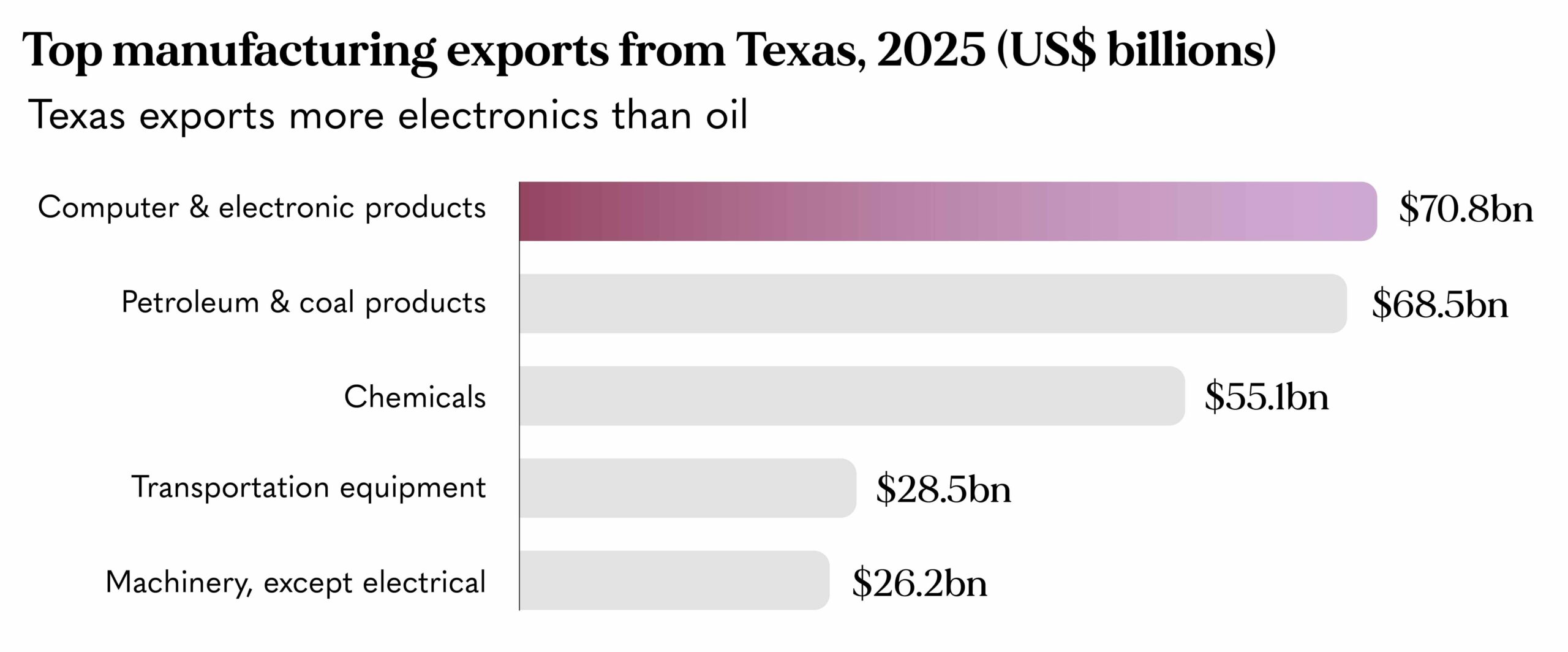
Source: Office of the United States Trade Representative
This shift did not begin with recent investment. Its origins lie in Dallas, where Jack Kilby, an engineer at Texas Instruments, built the first integrated circuit in 1958, joining several electronic components on a single piece of material (IEEE); the invention would later earn him the Nobel Prize in Physics (Britannica). From that laboratory, Texas grew into one of the places where the electronics industry took shape, and the story continues with the same company: At the end of 2025, Texas Instruments began production in Sherman, north of Dallas, at the first of up to four new chip factories (Texas Instruments). The chips made there are meant for cars, industrial equipment, and everyday electronics, the same kinds of goods that fill the trucks at Laredo. Together, the border and the chip describe a single economy, one that grows by connecting what is designed, made, and assembled in different places.
The potential of this industry lies less in the size of its investments than in what it draws around it. A chip factory needs engineers, technicians and suppliers, and with them schools, research and new residents; in Sherman alone, Texas Instruments expects to create about 3,000 jobs (Texas Instruments). It is also an industry that recruits its talent from many parts of the world, adding new voices to a state that has always grown through the people who arrived in it. In that sense, the chip continues the story of the border rather than replacing it: both turn the ability to connect different places, skills, and languages into a source of wealth.
Texas began with a word offered by those who were already there to those who had just arrived. Three centuries later, that exchange still shapes the state—on its bridges, and in its factories as much as in the way its people speak.