Language
From July’s issue of Global Perspective
Kashif Khalid
Translator
Kashif Khalid MCIL is an experienced linguist with over five years of expertise in the localisation sector. Specialising in English to Urdu, Punjabi, and Hindi translation, he seamlessly blends a passion for languages with an interest in cutting-edge AI technologies. Kashif is dedicated to exploring innovative industry solutions and ensuring high-quality, culturally accurate communication for a wide range of clients.
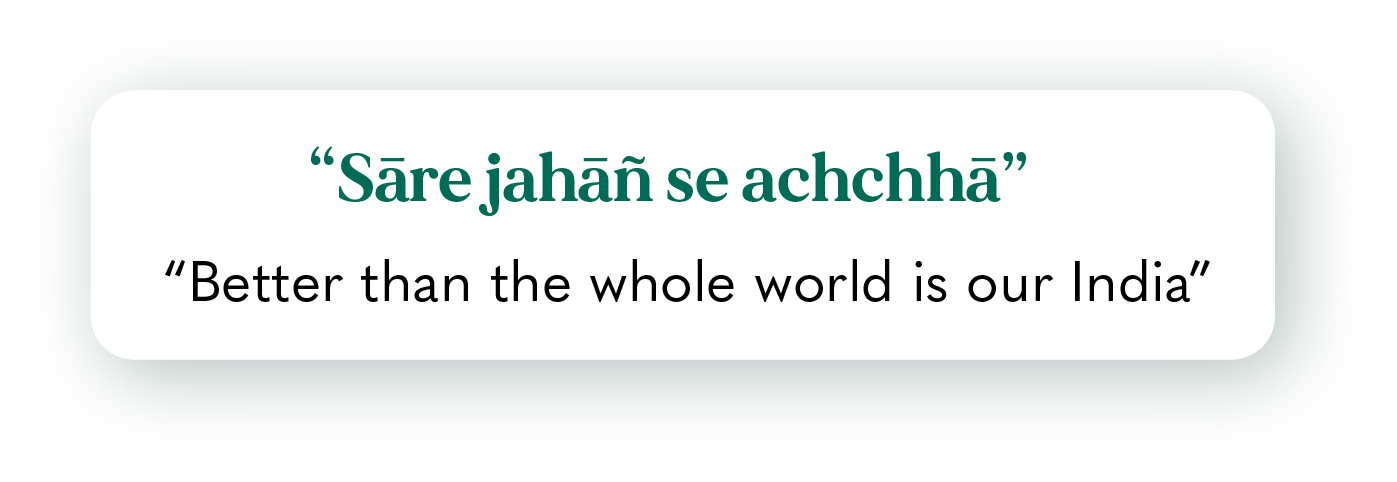
When Muhammad Iqbal wrote “Sāre jahāñ se achchhā (Better than the whole world is our India)” in 1904, he could not have known that within fifty years the country he extolled would split in two, and that his language would find itself in a peculiar position: the national tongue of Pakistan, where fewer than one in ten people speak it natively, and an increasingly marginalised one in the soil where it grew. By any standard test of what holds a language together—a single territory, a dominant native-speaker population, or robust institutional backing—Urdu should be in trouble.
And yet it isn’t. Urdu is spoken, written, recited, and loved by hundreds of millions of people from Karachi to Hyderabad, Lucknow to Bradford, Toronto to the Gulf. Something in its structure permits it to function as a homeland—a place of belonging—without requiring a corresponding patch of ground.
A Language Born in Contact
It helps to remember that Urdu was born in contact, not in isolation. It crystallized in the bazaars and garrison towns of northern India between the thirteenth and seventeenth centuries, when Turkic, Afghan, and Persian-speaking administrators settled among Indo-Aryan vernacular speakers. The grammatical skeleton remained Indo-Aryan with similar verb endings, postpositions, and basic word order. The aesthetic and lexical flesh was Perso-Arabic. Even the name Urdū derives from a Turkic root meaning “army” or “camp.” It was never the language of one place; it was a language of movement.
The Architecture of Flexibility
This origin embedded into Urdu a particular architectural flexibility. Consider the izāfat: a small Persian connecting particle (-e-) that links a noun to its qualifier, like in shām-e-ghazal (evening of song) or dil-e-nādān (innocent heart). The izāfat is not native to Indo-Aryan grammar, yet Urdu absorbed it so thoroughly that it became one of the language’s signatures.
Or consider its doubled lexical register: where Hindi has pānī (water), Urdu can also offer āb; where Hindi has āg (fire), Urdu offers ātish. A speaker can choose the homely word or the courtly one. This is not vocabulary in the ordinary sense; it is a built-in lever for tone, intimacy, and social positioning.
Script as Identity
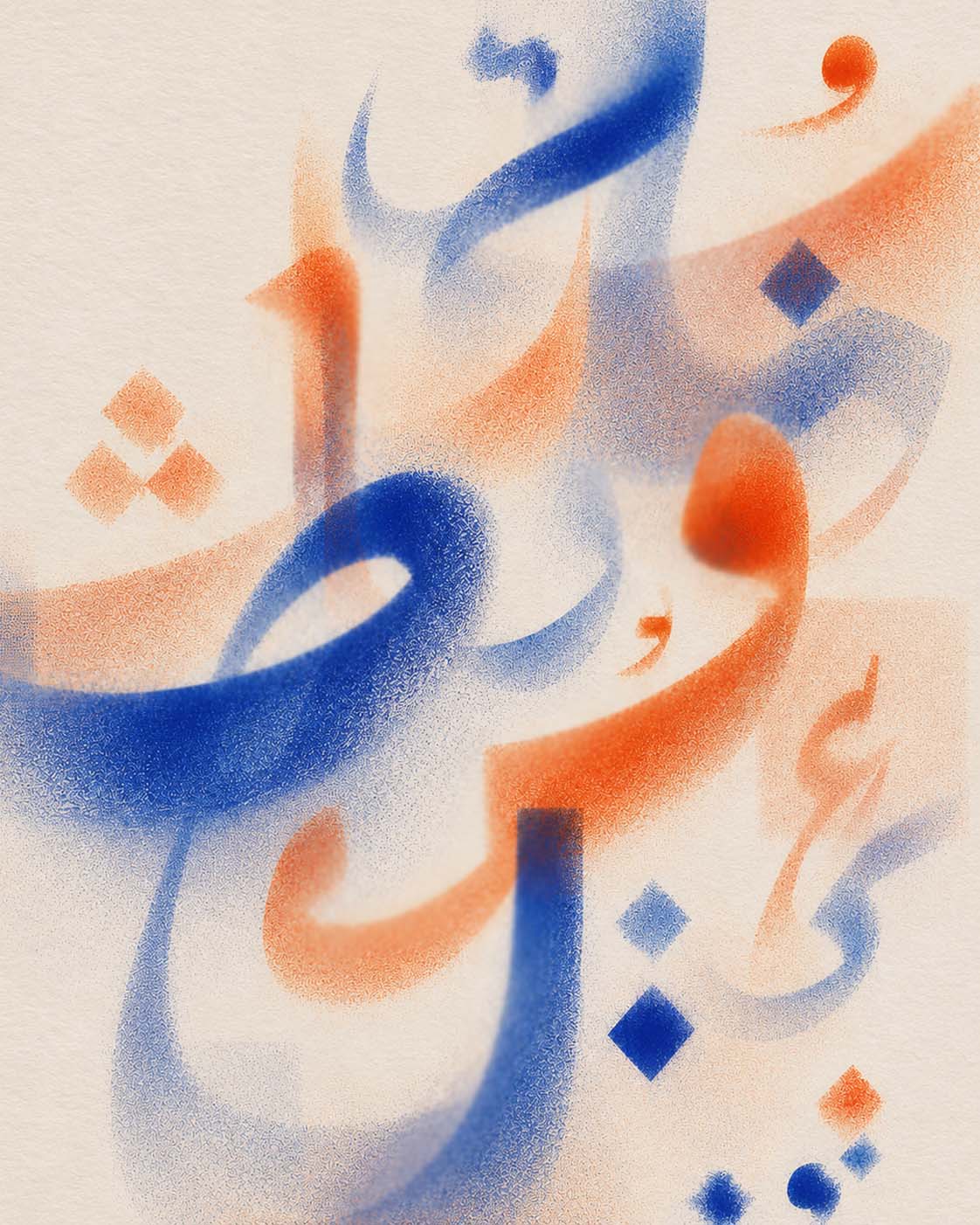
For most of its history, this layered language was carried by a script: Nastaliq, a calligraphic descendant of the Perso-Arabic alphabet, written from right to left, with letters that slope and curl like a kind of musical notation. When the Hindi–Urdu controversy hardened in the late nineteenth century, and decisively after Partition in 1947, script became inseparable from identity. The two languages—grammatically almost identical at the conversational level—diverged along this seam. Hindi turned toward a Sanskritised Devanagari; Urdu held to Nastaliq. The same sentence, spoken aloud, could be either. Written down, it became one or the other.
This was, in many ways, a loss. But it was also, accidentally, a strategy. Because Urdu’s identity was now carried less by territory than by orthography and literature, it could travel. A Nastaliq couplet shared as a WhatsApp status from a flat in Manchester is, in a small but real way, an act of national continuity.
Poetry as a Portable Institution
The other carrier is poetry. Few languages have so thoroughly fused their identity with a single literary form as Urdu has with the ghazal—a sequence of couplets, each self-contained, bound by rhyme and refrain. The ghazal is not merely a genre; it is a portable institution. A mushā’ira, the gathering at which poets recite to a responsive audience, can happen in a Lahore auditorium, a Birmingham community center, or a video call. A shared canon of Mīr, Ghālib, Iqbāl, Faiz, and Parveen Shakir functions as a common landscape that speakers carry with them.
“Hai aur bhī duniyā meñ sukhanvar bahut achchhe
Kahte haiñ ki Ghālib kā hai andāz-e-bayāñ aur”
“There are many fine poets in the world, they say
but Ghalib’s way of saying is something else”
The point is not Ghalib’s self-regard. It is that andāz-e-bayāñ (manner of saying) is itself a place. To recite this couplet, in Nastaliq, in the meter the line requires, is to step briefly into a country that has no border control.
Tahzīb: Belonging as a Practice
A third mechanism lies in what speakers call tahzīb: a word that translates loosely as culture, civility, or refinement, but really names a learned manner of being in language. Urdu has an elaborate honorific system—āp, tum, and tū are three different “yous,” each carrying social weight—and a register of indirect address that allows feeling to be conveyed without bluntness. Tahzīb is not legislated; it is transmitted, household to household, couplet to couplet, mushā’ira to mushā’ira. It is a way of belonging to a community that requires no passport, only practice.
A Homeland That Folds
So what allows Urdu to remain a homeland when it is no longer tied to a single place? Several things, working in concert: a script that carries identity visibly across borders; a literary canon dense enough to function as shared geography; a register system that encodes belonging in the act of speaking itself. Urdu was, from its beginnings, a language of contact rather than of soil. Partition did not make it stateless—it revealed that it had always been mobile.
Perhaps this is what linguistic perfection looks like, in the bottom-up sense: not a language that aspires to an abstract ideal, but one that has evolved, through centuries of upheaval, to remain habitable wherever its speakers find themselves.
The homeland, in Urdu’s case, is something you carry on the tongue and on the page. It folds. It crosses oceans. It opens again, intact, in another room.