Language
From July’s issue of Global Perspective
Languages are built to last. But the world they describe keeps moving, and not every language moves with it. New technologies, political ruptures, collective anxieties: these demand new words, and most languages struggle to coin them fast enough. The result is a gap between experience and expression, between what a society is living through and what it can actually say. A language that cannot keep pace with history risks becoming estranged from the people who speak it.
German has a structural answer to this problem. It generates new meaning by combining existing words into compounds: precise, flexible, and almost infinitely extendable. The mechanism is simple: words are merged into a new unit, in which each element contributes to the whole and the final word determines the core meaning, gender, and grammar. What this mechanism produces, however, is far from simple. It creates a language capable of absorbing the present tense of history almost as quickly as history moves.
The Everyday as Common Ground
The most ordinary compounds reveal something important about how this works. Fernweh puts a name to the ache of longing for a distant place. Kopfkino is the cinema playing in one’s head while imagining something. Drahtesel (“wire donkey”) is a humorous word for a bicycle.
None of these are literary inventions or philosophical coinages. They circulate in everyday conversation, and precisely because of that, they do something beyond description: They create a shared vocabulary for ordinary experience. When a way of living has a name that everyone uses, it becomes part of the common texture of a language and, through language, of a community. That same capacity to name what is familiar also makes it possible to give shape to what is newly unsettling.
When Language Keeps Pace with Technology
Every technological shift produces its own anxieties, and the speed at which those anxieties now circulate makes the need for precise language more urgent than ever. German compounds have proven particularly well-suited to this challenge. AI fatigue, or KI-Müdigkeit, is the exhaustion of being constantly pressured to adapt to new technology: a feeling that is widespread and real but had no precise linguistic form until the word gave it one. It is, in this sense, a distinctly contemporary compound, born of a moment when AI is reshaping work, communication, and daily life faster than most people can process.
German does not always need to invent new words for new conditions, however. Automatisierungsangst—the fear of automation—is a term that emerged during the Industrial Revolution and has resurfaced, largely unchanged, in the context of AI. The word did not need to be reinvented; it needed to be recalled. In using it, the language is doing something significant: It frames a new anxiety within a much longer story of technological disruption that societies have, eventually, learned to navigate.
What these words share is the capacity to transform diffuse, individual unease into something nameable and therefore collective. They move anxiety from the private sphere into the shared one. And a shared condition, unlike a private one, can be responded to.
Language as a Political Act
This becomes most visible when compounds engage directly with social and political friction. Wutwinter (“angry winter”) was coined in 2022 to describe a possible wave of protests driven by rising inflation and a broader sense that too many pressures were converging at once. The word did not simply record a mood; it anticipated one, giving dispersed unease a shape before it had fully formed.
Klimamüde works differently but follows the same principle. It does not signal the abandonment of environmental concern. Rather, it names the specific psychological mechanism by which people, overwhelmed by the scale of global problems and the apparent smallness of individual contribution, narrow their focus to what feels manageable. A single adjective captures a tension that is otherwise difficult to articulate. In both cases, the compound does something beyond description: It creates a common reference point from which a collective response becomes possible.
Zeitenwende takes this further still. The word is not new. It has appeared before, at other moments of historical rupture, and the deliberate recycling of it in recent years to describe fundamental shifts in German politics carries that history with it. Announcing transformation with a word that already exists implies continuity: This has happened before, and it was navigated. In this sense, Zeitenwende is not simply a political term. It’s an act of collective memory, a way of processing change without being entirely consumed by it.
When a Word Belongs to Everyone
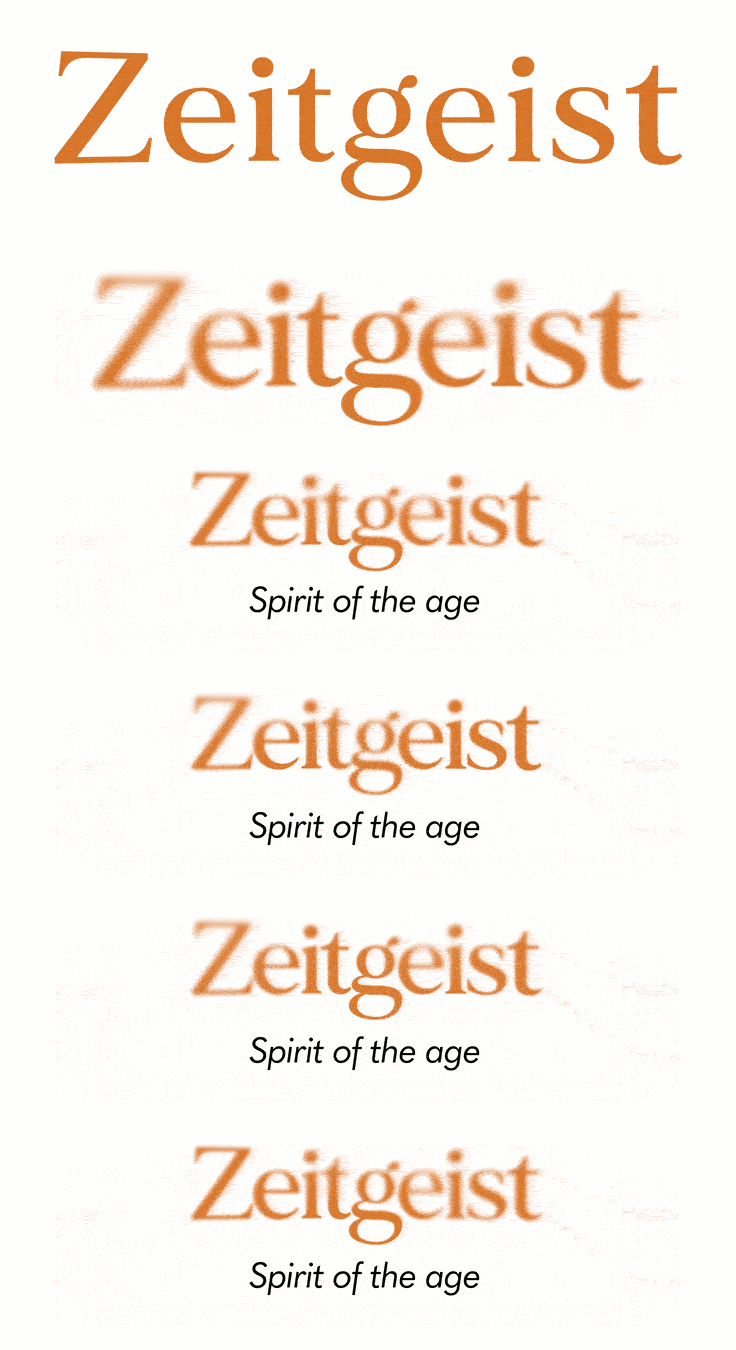
Some compounds prove so precise that they outgrow the language that created them. Zeitgeist is perhaps the clearest example. Often explained as “spirit of the age”, the translation captures only part of its meaning. Zeitgeist refers not simply to the mood of a historical moment but to the force that shapes its behavior, tastes, politics, and beliefs. English adopted the word in the nineteenth century and has never found a true equivalent, because no native expression performs quite the same function.
It is not alone. Kindergarten, Doppelgänger, and Weltanschauung crossed linguistic borders for much the same reason. They express ideas with a precision that translation struggles to match, becoming part of other languages rather than being replaced within them. When a language exports not just its words but the concepts they carry, it shows more than communicative efficiency. It reveals a system capable of giving lasting form to experiences others recognize as their own.
If there is such a thing as linguistic perfection, it is probably not the absence of limits but the ability to keep overcoming them. German compounds embody that idea. Built from familiar elements yet endlessly productive, they allow the language to expand without losing itself. Every new compound connects what is unprecedented to what is already understood, making change feel not alien but intelligible. From Fernweh to Zeitenwende, from KI-Müdigkeit to Zeitgeist, the principle remains remarkably consistent: History moves, and the language finds a way to move with it.