Trends
AI is transforming the way we research, design and build. This new condition, among others, lies at the heart of the 2025 Biennale Architettura in Venice: Intelligens. Natural. Artificial. Collective., which I have the privilege of directing this year. Many projects explore the intersection of intelligence and imagination—from Refik Anadol’s data-driven installations to several experiments at the frontiers of design and computation.
It is with excitement, then, that I take on the question: what can AI do in our practice? The good news: AI is not the end of the architect, but it redraws the boundaries of the work.
When people mention “AI” today, they often mean large language models such as ChatGPT. Yet, in a broader sense, artificial intelligence has existed for decades.
It began in the 1950s with the pioneering work of Alan Turing, who proposed that machines could simulate human intelligence. His Turing Test remains a benchmark for assessing a machine’s ability to exhibit human-like reasoning: a human judge interacts with both a machine and another human through text, and if the judge cannot reliably distinguish between them, the machine is considered intelligent.
In the 1960s and 1970s, research expanded with symbolic AI and expert systems, though limited computing power caused setbacks. By the 2000s, advances in data and processing power fueled breakthroughs in neural networks. Modern AI, powered by deep learning, now underpins countless applications.
What can AI do in our practice? The good news: AI is not the end of the architect, but it redraws the boundaries of the work.
There are, however, shared principles. From early systems to today’s deep learning, AI encompasses any method that allows machines to learn patterns and make predictions. All AI systems are built on a central concept: a computer model is fed data (known as a training set) to teach it to perform specific tasks such as recognizing images, understanding language, or making predictions.
Through exposure to data, the system “learns,” often achieving results that surpass human-designed rules. Yet the inner workings of many modern models are highly complex and not easily interpretable. Even their creators may struggle to fully understand how specific decisions are made, leading to the notion of AI’s “black box” functioning.
At the Senseable City Lab, we began using AI systems several years ago, particularly in the form of deep-learning, which allowed us to process visual information at scale. Today, the city is recorded continuously, from satellites, sensors, and tools like Google Street View. We started training deep-learning systems to segment urban scenes and identify different elements: trees, people, materials, and more. We called this Urban Visual Intelligence. What once took teams of researchers weeks can now be done in minutes.
We started with trees. Our Treepedia project applied AI to detect and map urban greenery in cities worldwide. Using data from Google Street View, by simply quantifying green pixels we taught the system to infer what was most likely urban greenery (trees, bushes, grass) across large swaths of global cities. By analyzing canopy cover and making it publicly accessible through online maps, Treepedia became a tool for residents to advocate for more equitable green space; a reminder that data can serve civic purposes.
As AI models advanced, we have extended our work on urban greenery to identify individual trees in the city, using thermal imagery to assess how different tree species contribute to cooling down our cities, or to demonstrate how residents of cities in diverse climatic areas of the world value nature differently.
We then turned to study how people use public spaces, following a line of research pioneered by urbanist William H. Whyte in the 1970s and 1980s. Whyte, who filmed plazas and parks in New York, was fascinated by where people chose to sit, how they navigated space, and what drew them together.
We started training deep-learning systems to segment urban scenes and identify different elements: trees, people, materials, and more. We called this Urban Visual Intelligence. What once took teams of researchers weeks can now be done in minutes.
His findings, documented in The Social Life of Small Urban Spaces (1980), were often beautifully simple: “What attracts people most, it would appear, is other people.” From his footage, Whyte derived data-backed recommendations: seats should be “two human backsides deep,” and movable chairs should allow people to chase sun or shade. His analysis helped save New York spaces such as Bryant Park and shaped our modern approach to people-centered design.
Whyte’s experiments were revelatory but hard to replicate. Analyzing the footage frame by frame took a team of assistants months. Now, that challenge has finally been overcome through deep learning. Our team digitized Whyte’s original footage and compared it with recent videos–of Bryant Park, the steps of the Met Museum in New York, Boston’s Downtown Crossing, and Philadelphia’s Chestnut Street. We trained an AI model to analyze both sets of footage, tracking hundreds of people at once. What took Whyte months now takes minutes.
We discovered that people’s behavior in cities has changed significantly between 1970 and 2010. As we discuss in a recent paper in the Proceedings of the National Academy of Sciences, walking speeds in these U.S. cities have increased by 15%. People stand still less often. Dyads (pairs meeting and then walking together) have declined. Downtown Crossing in Boston, once lively and social, has become a pass-through. Even in Manhattan’s Bryant Park, improved according to Whyte’s vision, the number of social interactions has fallen. Cities have not emptied, but a part of their essence has thinned. Only with AI could this level of visual evidence be read at scale.
Turning to the present, large language models (LLMs) such as ChatGPT extend AI beyond vision and into language. Trained on vast amounts of human text, they can generate plausible, although sometimes hallucinatory, answers to almost any query.
Their energy use and scale are enormous, but so is their reach: they are becoming general-purpose tools. They can initiate writing a paper, perform extensive prior-art searches, and generate synthetic images.
This latter possibility is now common in most design offices, where LLMs help gather ideas and generate initial sketches. We do the same at CRA-Carlo Ratti Associati. A few years ago, an architect seeking inspiration for a house beside a waterfall might have searched online and found Frank Lloyd Wright’s Fallingwater alongside a handful of precedents. The designer would have synthesized those references into an idea.
Today, LLMs can do the same, but at scale. They have been pre-trained on tens of millions of images. They can sift through millions of references in seconds, producing synthetic outputs that offer a starting point for conversation and experimentation.
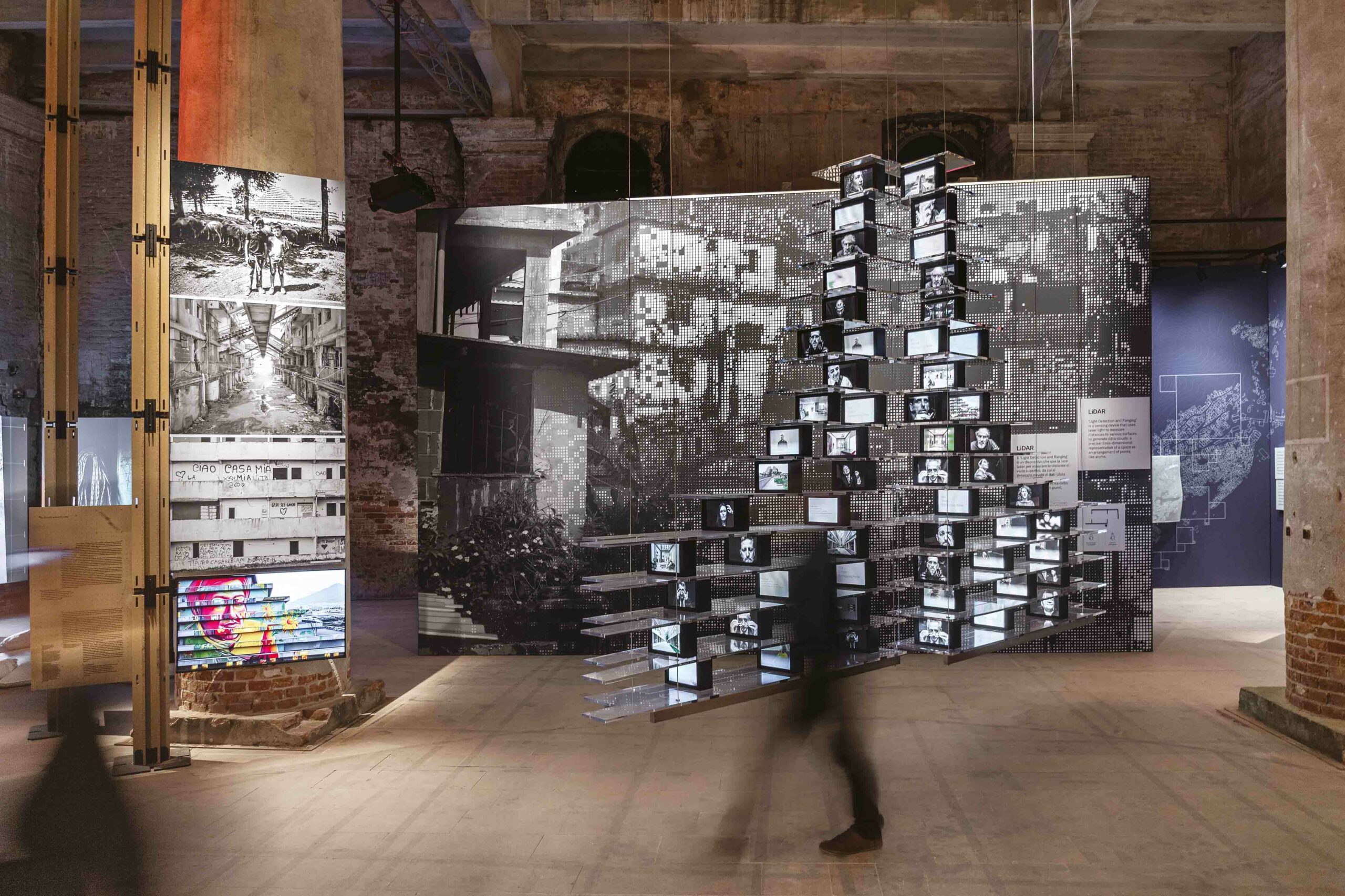
Another interesting application is that LLMs allow people with no formal training in design to iteratively produce visual contributions that reflect their preferences. We have been testing this ability to improve participation in architecture through another project shown at the 2025 Biennale Architettura in Venice, a participatory design exercise focused on the modernist complex of the Sails of Scampia.
On the outskirts of Naples, the Sails of Scampia stand alongside legendary housing experiments like Pruitt-Igoe in St. Louis and Robin Hood Gardens in London, grand architectural visions that ended in demolition. Immortalized globally as the backdrop of Netflix’s Gomorra, the Sails have long symbolized social failure.
Unlike those other cases, which were fully demolished, part of the Naples complex–the Vela Celeste–is set to remain and undergo a radical renovation. Stripped of its internal partitions, it is being reimagined through an innovative participatory design process.
In the past, community participation was limited by the difficulty laypeople faced in translating their ideas into sketches and drawings. Residents often lack the technical vocabulary or representational tools to communicate their spatial ideas. As recent research in the Lab has shown, LLMs can bridge this gap by acting as interpreters, turning stories, memories, and local idioms into clear design briefs, visual prompts, and planning proposals.
They can process hours of recorded interviews, extract recurring themes–such as the need for shaded terraces, open courtyards, or spaces for art and education–and summarize them into shared priorities. When connected to generative design tools, these summaries can yield visual prototypes that residents can comment on, modify, or reimagine. In this way, AI becomes not a top-down design instrument, but a platform for dialogue and iteration.
LLMs can create a synthetic Fallingwater, but they cannot create a new Frank Lloyd Wright. They can generate infinite permutations of what has already existed, but not what has never been done. They remain bounded by their training sets, however large.
From deep learning for urban analysis to LLMs for inspiration or participation, the potential uses of AI in design are manifold. In addition to these, we could add a range of general-purpose features; assistance in writing texts, finding references, or formatting, that can be applied across many professions.
Yet there are also limitations. They can all be ascribed to the same constraint: the training set. Every system can only do what is contained within the data it has been fed. If we return to the example of the house beside a waterfall: LLMs can create a synthetic Fallingwater, but they cannot create a new Frank Lloyd Wright. They can generate infinite permutations of what has already existed, but not what has never been done. They remain bounded by their training sets, however large.
In the field of design, one way to describe this is perhaps in the words of the great architecture critic and historian Bruno Zevi, who once wrote:

In every era there has been plagiarism, imitation, the “false modern.” Authentic artists–creators of language–are always very few; around them stand professionals who build correctly, perhaps even elegantly, but in prose, not in poetry. Then comes the tide of imitators, who confuse the grand with the grandiose. Ignoring the lexicon, grammar, and syntax of modernity, they build “in the modern style,” that is, in the best of cases, without communicating anything at all.

If we use Zevi’s framework, we might say that AI signals the automation of a certain kind of design: repetitive and rooted in the past. Yet as humans, we retain the key thing that makes us human: the power to imagine what has not yet been captured in the past. The change of paradigm. For now, what AI cannot do–speculate, and dream beyond data–remains our domain.
This article is adapted from a piece by Carlo Ratti, first published by RIBA Publishing in the volume AI, Sustainability and the Design Process, edited by Professor Alessandro Melis (NYIT).


Carlo Ratti
Carlo Ratti is a scientist, designer, and public intellectual working on the future of cities and the built environment. He teaches at the Massachusetts Institute of Technology (MIT), where he directs the Senseable City Lab, and is a Distinguished Professor of Urban Studies at the Politecnico di Milano. He is also a founding partner of the international design and innovation office CRA-Carlo Ratti Associati. As a consultant to leading NGOs and governments, Ratti has been shaping the global debate on cities and is one of the most-cited scholars in the field of urban planning today.
References
- La Biennale di Venezia (2025) Living Architecture: Biophilia. Available at: https://www.labiennale.org/it/ architettura/2025/artificial/living-architecture-biophilia
- Turing, A.M. (1950) ‘Computing Machinery and Intelligence’, Mind, 59(236), pp. 433–460. Available at: https://academic.oup.com/mind/article-abstract/ LIX/236/433/986238
- MIT Senseable City Lab (2016) Treepedia. Available at: https://senseable.mit.edu/treepedia
- I Seiferling, N Naikc, C Ratti, R Proulx (2017). Green streets − Quantifying and mapping urban trees with street-level imagery and computer vision. Landscape and Urban Planning 165: 93–101
- Klimenka, M., Mora, S., Abuhani, D. A., Norford, L., Duarte, F., Ratti, C. (2025). Cooling performance: Exploring the heat mitigation effect of urban trees with computer vision. arXiv.
- Lefosse, D., Duarte, F., Sanatani, R., Kang, Y., van Timmeren, A., Ratti, C. (2025). Feeling Nature: Measuring perceptions of biophilia across global biomes using visual AI npj Urban Sustainability, 5(4), 1-13.
- 7 Whyte, W.H. (1980) The Social Life of Small Urban Spaces. New York: Project for Public Spaces.
- Salazar-Miranda, A., Fan, Z., Baick, M., Hampton, K., Duarte, F., Loo, B., Glaeser, E., Ratti, C. (2025). Exploring the social life of urban spaces through AI Proceedings of the National Academy of Sciences, 122, 1-8
- La Biennale di Venezia (2025) Vela Celeste: Reimagining Home. Available at: https://www. labiennale.org/it/architettura/2025/collective/vela- celeste-reimagining-home
- Haddad, F., Jang, K., Duarte, F., Rajaonson, J. and Ratti, C. (2025) ‘User-centered evaluation of visual generative AI for city design: an exploratory technology acceptance model analysis’, Cognition, Technology & Work, pp. 1–16. Available at: https://www.tandfonline. com/doi/full/10.1080/24694452.2024.2313515
- Zevi, B. (1948) Saper vedere l’architettura. Torino: Einaudi.