
Language
Introduction
The transition of the Kazakh language from Cyrillic to the Latin alphabet is one of the most ambitious linguistic and cultural reforms in the post-Soviet world. Announced in 2017 as part of the national modernization program Rukhani Zhangyru (“Spiritual Renewal”), the reform aims not only to adapt Kazakh orthography to the realities of the digital era but also to assert a renewed national identity that reflects Turkic heritage rather than Russian legacy. Letters become the destiny of a language and in Kazakhstan, they also chart the path of a nation’s cultural evolution.
Originally designed for Latin and later molded by Romance languages, the Latin script has long been repurposed by non-Romance languages to accommodate unfamiliar phonologies. Each adaptation becomes a mirror of linguistic ingenuity and cultural aspiration. For Kazakh—a Turkic language with complex vowel harmony and distinct uvular consonants—the adoption of the Latin script has demanded not just orthographic recalibration but also a redefinition of identity.
From Cyrillic Legacy to Latin Revival
Kazakh has historically oscillated between scripts. It was written in the Arabic script until 1929, then briefly in the Latin-based Yañalif, and finally in the Cyrillic alphabet from 1940—a change imposed by Stalin’s policy of centralization and Russification. The Cyrillic period embedded Russian orthographic conventions deeply into Kazakh literacy. Many linguists today describe Cyrillic as “an imposed alphabet that disconnected the language from its Turkic kin.”
Thus, the current reform is not merely linguistic; it represents an attempt to de-Russify Kazakh, reconnect it with the broader Turkic world and align it with global digital systems that overwhelmingly rely on the Latin script.
Alphabet Modifications
The earliest official version of the new Latin alphabet, approved in October 2017, employed apostrophes to denote Kazakh sounds absent from standard Latin orthography. For example, a’, g’, and n’ represented /æ/, /ɣ/, and /ŋ/. However, the system drew swift criticism for being visually cluttered and digitally unworkable: apostrophes broke search queries and web addresses.
By early 2018, a second draft replaced apostrophes with digraphs: multi-letter combinations such as ae, oe, ue, ng, sh, ch, zh. This meant that the word сәбіз (säbiz, “carrot”) appeared as saebiz, the city name Актөбе (Aqtöbe) became Aqtoebe, and күн (kün, “day”) turned into kuen.
These forms were easy to type on a QWERTY keyboard but problematic phonetically:
- saebiz could be parsed as /sae-biz/ rather than /sæ-biz/;
- aqtoebe obscured the front-rounded vowel /ø/;
- kuen distorted vowel harmony between /y/ and /ø/.
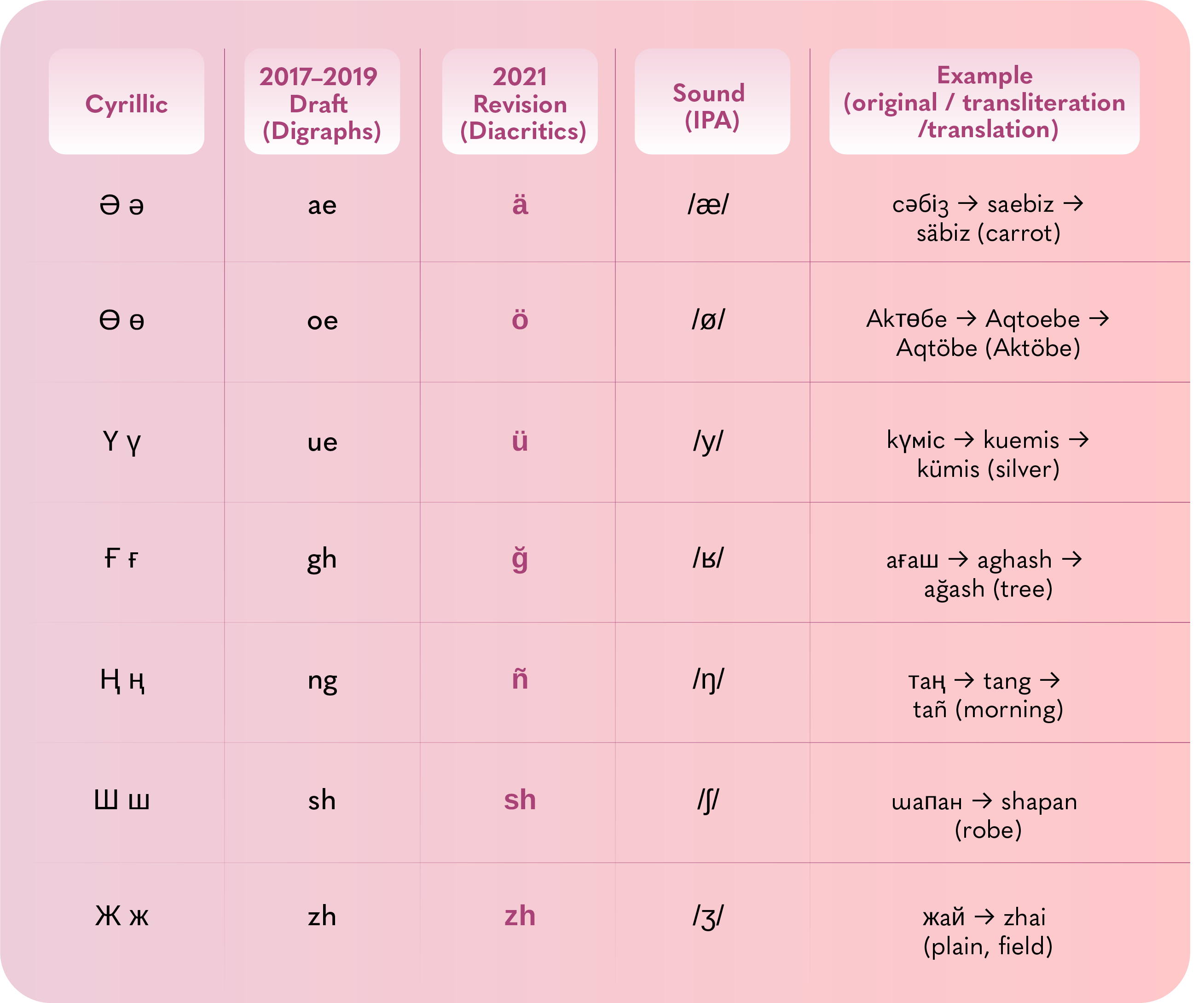
By 2021, President Tokayev’s administration endorsed a diacritic-based version (ä, ö, ü, ğ, ñ, ş, č, etc.), aligning Kazakh with other Turkic Latin systems and restoring one-sound-one-letter precision. This revision not only improved phonemic transparency but also carried cultural symbolism: umlauts and tildes visually connected Kazakh with Turkish, Azerbaijani, and Uzbek orthographies, reinforcing pan-Turkic solidarity and linguistic sovereignty.
Lexical Transformation and Orthographic Simplification
While officially an orthographic reform, Latinization indirectly reshapes vocabulary. Under Cyrillic, Russian loanwords dominated: полиция (police), газета (newspaper), цирк (circus). In Latin script, these become polisia, gazet, sirk, stripped of Russian orthographic cues and visually re-Kazakhized.
Technical and digital terminology also adapts naturally: startup, IT, email, coding integrate seamlessly without transliteration, unlike their Cyrillic forms (стартап, имейл). The shift therefore normalizes international vocabulary within a Kazakh grammatical frame.
Another layer is the re-emergence of Turkic synonyms that once yielded to Russian borrowings. For instance, the native әуежай (äuežai, “airport”) increasingly replaces аэропорт (aeroport), while бекет (beket, “station”) competes successfully with the Russified станция. The Latin script visually distinguishes such indigenous lexemes from their Cyrillic-Russian counterparts, reinforcing linguistic autonomy.
Cyrillic evokes the Soviet period, a visual reminder of Russian cultural dominance, whereas the Latin script projects a future-oriented, globally connected, and technologically fluent nation.
Between English and Turkic Worlds
Kazakhstan’s Latinization stands at the intersection of Anglicization and Turkification. English dominates global science, commerce, and digital platforms, and Latin letters facilitate seamless integration into this ecosystem—coding languages, URLs, and academic exchange all presuppose Latin script.
Simultaneously, the reform draws Kazakhstan closer to its Turkic neighbors. The new letters ä, ö, ü, ğ, ñ mirror Turkish ä/ö/ü/ğ and Azerbaijani ə/ö/ü/ğ patterns, enabling mutual intelligibility of printed text and signaling a common cultural lineage.
A sentence like Менің атым Айгүл (“My name is Aigül”) illustrates this dual orientation:
| Cyrillic | Менің атым Айгүл |
| Latin 2017 | Menıng atym Aıguel |
| Latin 2021 | Meniñ atym Aigül |
| Transliteration | Meniŋ atym Ajgül |
The 2021 form preserves nasal ñ and rounded ü clearly, maintaining Turkic phonology while remaining legible internationally.
National Identity and Cultural Symbolism
Script reform in Kazakhstan functions as an act of symbolic politics. Cyrillic evokes the Soviet period, a visual reminder of Russian cultural dominance, whereas the Latin script projects a future-oriented, globally connected, and technologically fluent nation. For younger citizens raised in multilingual digital environments, the Latin alphabet feels natural and empowering. For older generations, however, it risks severing access to literature and archives preserved in Cyrillic, turning the reform into a generational divide as well as a linguistic one.
Every script shift in Kazakh history (Arabic → Latin → Cyrillic → Latin again) has coincided with ideological transformation. The current reform, blending pragmatism, nationalism, and modernity, encapsulates Kazakhstan’s effort to reimagine its identity in the 21st century.
The Latinization of Kazakh represents far more than orthographic modernization. It intertwines linguistic engineering, digital adaptation, and cultural self-definition. As Kazakhstan advances toward full implementation by 2031, its experience demonstrates that an alphabet can be both a technical tool and a declaration of identity.
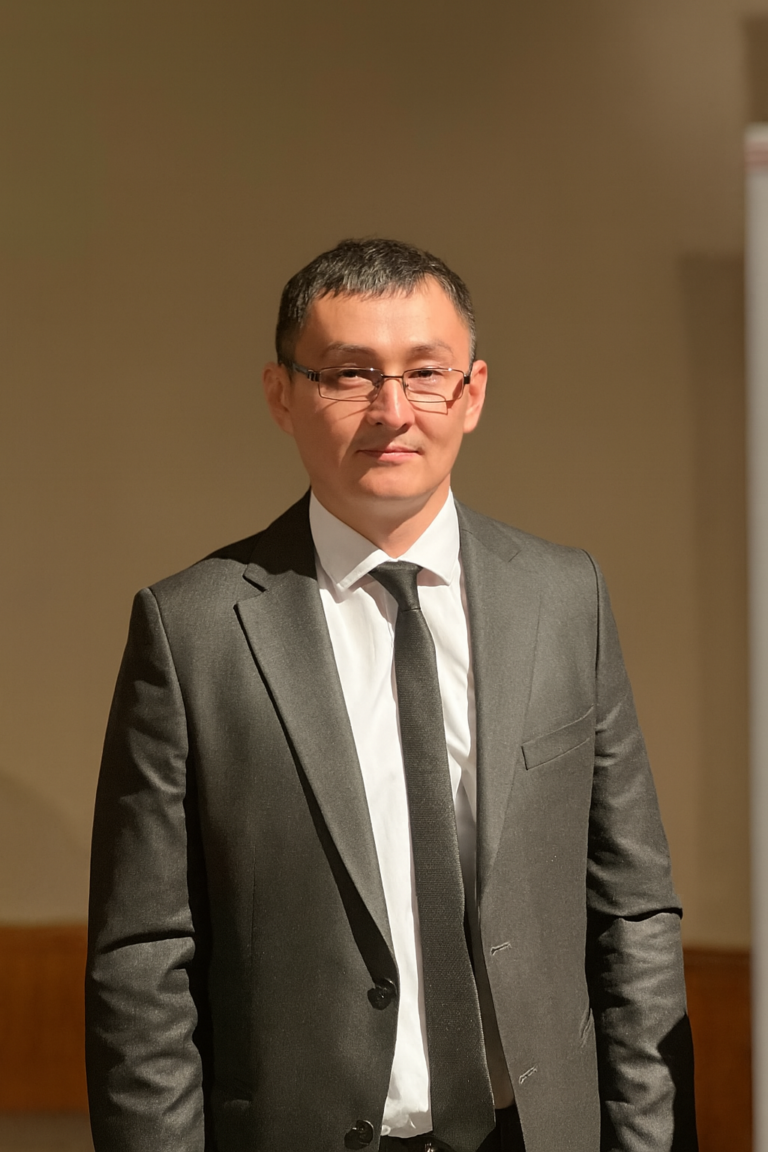
Timur Sulbayev
Linguist, Educator & Researcher
Timur Sulbayev is a linguist, educator, and researcher from Kazakhstan with a strong interest in language policy, orthographic reform, and Turkic linguistics. He has taught English, Turkish, and Arabic, and has authored several publications on multilingual education and language competency. Timur holds a Master’s degree in Philology and has pursued doctoral studies focused on foreign language education. His work explores the intersection of language, identity, and cultural transformation in Central Asia.