
Language
The Need for Transformation
The year was 1928—a time of sweeping change across the globe and, within Türkiye, a revolution in thought, identity, and language. Under the visionary leadership of Mustafa Kemal Atatürk, the Republic of Türkiye embarked on a bold mission to modernize, secularize, and redefine itself after centuries of imperial rule.
At the heart of this transformation lay a monumental linguistic decision: to replace the Arabic script with the Latin alphabet. This was far more than a technical reform—it was a cultural and ideological milestone.
The Arabic script, tied to Ottoman administrative and religious traditions, was ill-suited to Turkish phonetics. It hindered literacy and alienated the wider population from education and governance. The Latin script offered simplicity, precision, and a faithful reflection of spoken Turkish. It marked a clean break from the Ottoman past and a decisive step toward a modern, unified, and literate Republic.
Language in the Ottoman Empire
In the Ottoman Empire, language mirrored hierarchy. Ottoman Turkish—a complex blend of Turkish, Arabic, and Persian—was the language of the elite and bureaucracy. It was ornate, layered, and accessible only to the educated few. The Arabic script deepened this divide, turning written language into a privilege.
Among the common people, a more natural Turkish prevailed—rooted in everyday speech, folk traditions, and oral storytelling. This vernacular was the language of the streets and villages, a living, breathing reflection of the nation itself.
Precisely this linguistic duality symbolized the cultural and educational gap between rulers and the ruled. For the Republic, closing it was essential to building a cohesive national identity.
From Arabic to Latin Script
Arabic script was designed for Semitic languages, not Turkic ones, creating a constant mismatch. Key challenges included:
- Inadequate Representation: Turkish vowels and consonants could not be accurately expressed, causing confusion and inconsistency.
- Low Literacy Rates: Complexity limited literacy to a narrow elite, restricting access to knowledge and opportunity.
For a Republic built on the ideals of education, equality, and unity, this was untenable. Reforming the script became a revolutionary act of social inclusion and national empowerment.
The adoption of the Latin alphabet was carefully planned to meet the needs of modern Turkish. It was phonetic, logical, and easy to learn—perfectly aligned with the rhythm and sound of the spoken language. Advantages included:
- Phonetic Clarity: Each letter represented a single, distinct sound.
- Ease of Learning: Citizens from all walks of life could quickly gain literacy, democratizing education and communication.
The reform bridged the gap between written and spoken word, transforming the alphabet into a tool of unity rather than exclusion.
Crafting the Turkish Latin Alphabet
Adapting the Latin script required careful innovation. The new Turkish alphabet introduced letters that captured the sounds of the language while preserving linguistic integrity:
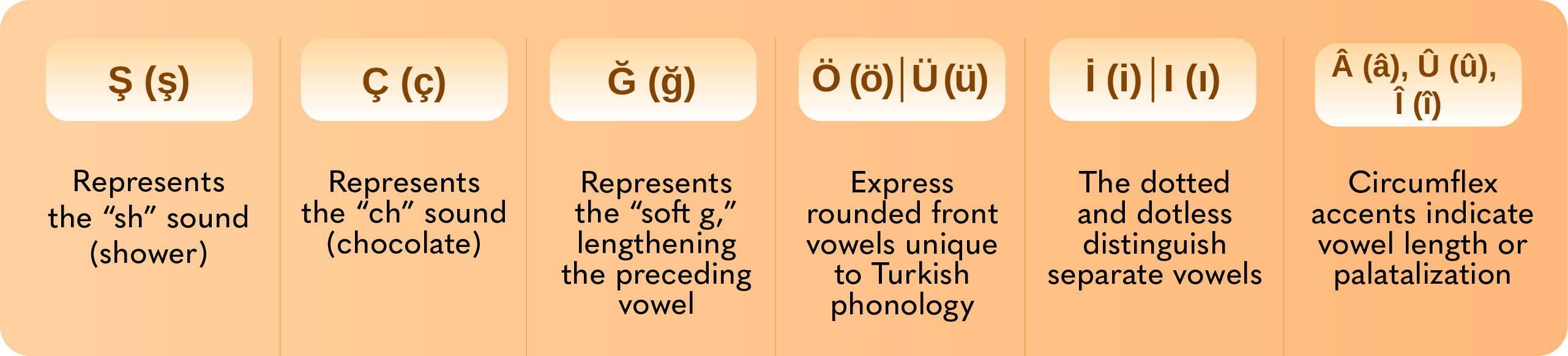
These additions ensured that no element of Turkish phonology was lost. The new alphabet was simple, elegant, unmistakably Turkish—a symbol of progress without erasing identity.
From Ottoman Layers to Modern Openness
The alphabet reform was followed by a broader language reform aimed at simplifying vocabulary and freeing Turkish from excessive Arabic–Persian influence. Many loanwords were replaced with revived or newly coined Turkish equivalents. For example, mektup (letter) began to coexist with yazı, and edebiyat (literature) gradually gave way to yazın.
This not only simplified written communication but reconnected the language to its Turkic roots, making it more accessible and nationally unified.
Reforming the script became a revolutionary act of social inclusion and national empowerment.
Moreover, the Latin script opened Türkiye linguistically and culturally to the West. In the decades that followed, new concepts from technology, science, and culture entered Turkish through European languages—first French, then English. Words such as televizyon, futbol, and internet reflect this exchange. Yet Turkish has shown remarkable adaptability, coining native terms like bilgisayar (“computer”) to maintain linguistic independence while engaging with global innovation.
A Strategic and Symbolic Transformation
The alphabet reform was one of the clearest expressions of the Republic’s founding philosophy. It was not merely linguistic but civilizational: a break from the Ottoman legacy. Furthermore, it was a turn toward modernity: the Latin script aligned Türkiye with the modern Western world, embodying Atatürk’s vision of a secular, rational, and forward-looking nation.
But most importantly, it was the foundation of a democratic language. Simplifying written Turkish opened up education to all, uniting citizens under a common linguistic identity and fostering national consciousness. The new alphabet became a cultural emblem of independence—a declaration that Türkiye would define its own future, both linguistically and intellectually.
The 1928 adoption of the Latin script was one of the most transformative reforms of the early Republic. By aligning written and spoken Turkish, the reform empowered citizens, advanced literacy, and forged a shared national identity. Beyond language, it embodied the Republic’s larger mission: to embrace modernity without losing authenticity, and to build a nation confident in its voice, values, and vision.In embracing the Latin script, Türkiye did not merely change its alphabet—it rewrote its destiny.

Arzu Altinay
Language Lead, Localization, Translation & Interpretation
Arzu Altınay is a freelance translator, interpreter, and localization expert with over 30 years of experience working across law, energy, IT, marketing, tourism, and cultural sectors. She serves as Turkish Language Lead and localization specialist for major global clients, including Uber, Airbnb, Glovo, Roblox, and Coupa, delivering high-precision Turkish–English language projects and terminology work. A sworn-in translator since 1997, she holds an MA in English Literature from Hacettepe University. Based in Turkey, she works between Bodrum and Ankara while also contributing to research and writing on language, scripts, and cultural transformation.