
Language
Maltese presents one of the most intriguing linguistic adaptations in the world: a Semitic language expressed entirely through the Latin script. Put simply, one may argue that Maltese is Latinized Arabic. Spoken on a small Mediterranean archipelago long defined by cultural intersections, Maltese evolved from Arabic roots, yet reflects centuries of contact with Italian, Sicilian, and English. Its adoption of the Latin alphabet was not merely an orthographic choice but a symbolic act of cultural negotiation between the island’s Semitic linguistic heritage and its European sociopolitical orientation, particularly after centuries of colonization.
The Latin alphabet was first used for Maltese around the late 15th century, with the earliest known examples appearing in a 1436 notarial document containing Maltese place names transcribed in Latin script. In the 16th and 17th centuries, isolated texts and glosses appeared in Latin or Italian works, showing ad hoc Latin spellings for Maltese words. Systematic use emerged much later, in the late 18th century to be precise, through the work of Mikiel Anton Vassalli, often called the father of the Maltese language, whose grammar and dictionary laid the foundations for modern orthography.
The alphabet was formally standardized in 1924, establishing the 30-letter system still used today. When people first started writing Maltese using the Latin alphabet, they had to find ways to write down sounds that do not exist in Italian, English, or other Romance languages, but which existed in Arabic. With no established spelling system yet, early writers simply tried their best, often copying Italian spelling conventions. But Italian does not have letters for these Semitic sounds, so people wrote the same word in different ways. While 24 out of the 30 letters use symbolism from the standard Latin set, six use uniquely modified or repurposed symbols. These innovations allowed the script to represent Semitic phonemes accurately, bridging the gap between Arabic sound structures and European orthographic expectations.
Key examples include:
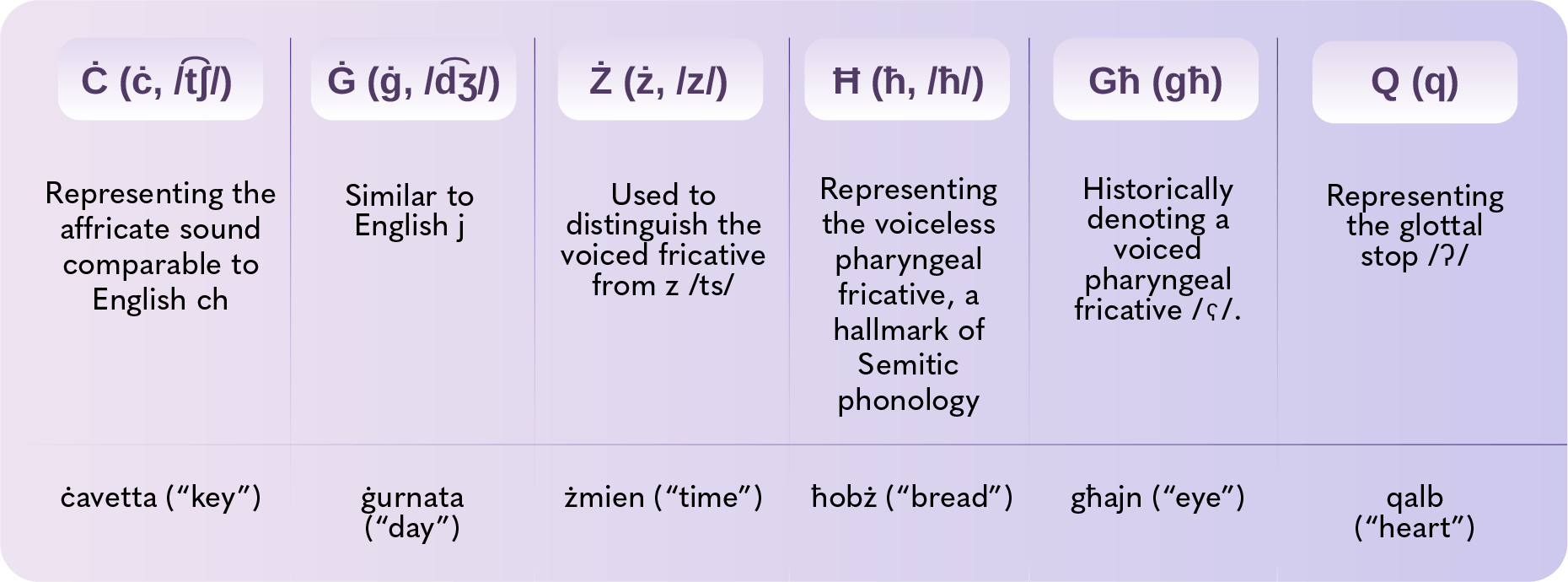
The transition to Latin orthography also coincided with profound lexical change. While Maltese grammar remained Semitic, and a significant number of words derive from similar Arabic counterparts, large portions of its vocabulary became Romance or, more recently, English in origin. This hybridization occurred gradually through centuries of trade, colonization, and education under successive powers. Many Arabic-derived words were phonetically adapted to Latin orthography. The spelling of these words shows how the Latin script sought to approximate Semitic sounds while remaining accessible to readers familiar with Italian or English conventions.
| Sabiħ | صبيح (Ṣabīḥ) | “Beautiful” |
| Dar | دار (Dār) | “House” |
| Ħobż | خُبْز (Khubz) | “Bread” |
At the same time, Maltese borrowed heavily from Sicilian and Italian, particularly in domains of religion, law, and the arts. Many words entered the lexicon seamlessly, adopting Maltese phonetic rules and stress patterns.
| Skola | Scuola | “School” |
| Pajjiż | Paese | “Country” |
| Ċertifikat | Certificato | “Certificate” |
During the British colonial period, new semantic fields emerged through English influence, especially in science, technology, and administration. Terms like kompjuter (“computer”), friġġ (“fridge”), and report (“report”) demonstrate orthographic adaptation using Maltese phoneme-to-grapheme conventions.
The most interesting observation here is that, while the Maltese adapted the Latin script to accommodate Semitic sounds and eventually to write Arabic words, they also adapted Romance and Anglo-Saxon words to their existing phonology and lexicon, making Maltese truly a unique, hybrid language.
Linguistically, modern Maltese grammar retains its Semitic backbone: verbs are based on triliteral roots (kiteb “he wrote,” ktibt “I wrote”), and prepositions are often suffixed to pronouns (miegħek “with you,” from ma’ + -ek). However, its lexicon is estimated to be over 50 percent Romance or English in origin. This blend makes Maltese a paradigmatic case of linguistic hybridization, where structural and lexical components derive from different language families but function seamlessly within a single communicative system. Hybridization also extends to syntax and discourse. English–Maltese code-switching is common, especially among younger speakers, creating a fluid linguistic repertoire that challenges traditional boundaries of language identity. In this context, the Latin script serves not only as a tool for writing but also as a visual anchor, linking these diverse linguistic elements and paving the way for the language’s codification, standardization, and cultural assertion.
The adoption of the Latin script profoundly influenced Maltese cultural identity. It represented not only a practical solution for writing but also a symbolic alignment with Europe rather than the Arab world. During the Language Question of the nineteenth and early twentieth centuries, when Italian and English competed for official status on the islands, the use of the Latin alphabet allowed Maltese to assert itself as both authentically local and recognizably European.
The alphabet stands as a metaphor for Malta itself, a meeting point of linguistic and cultural currents, resilient yet adaptive, distinct yet interconnected.
Meanwhile, the orthographic standardization of 1924 coincided with a growing national movement that sought to elevate Maltese from “dialect” to “language.” Writing the language in Latin letters was instrumental in this process. It enabled print publication, education, and codification, transforming Maltese from an oral vernacular into a medium of literature, journalism, and administration.
Today, the Latin script is regarded as an integral part of Maltese identity, not as a colonial imposition. It embodies the island’s historical capacity for synthesis: Semitic in structure, Romance and English in vocabulary, European in script. The alphabet stands as a metaphor for Malta itself, a meeting point of linguistic and cultural currents, resilient yet adaptive, distinct yet interconnected. Through innovative letters, selective borrowing, and creative hybridization, the Maltese script came to reflect both the island’s complex history and its evolving sense of identity.
As the only Semitic language written in the Latin alphabet, Maltese exemplifies how scripts can transcend their origins, becoming vessels of cultural transformation. Its orthography remains a living record of Malta’s dialogue between past and present, between the phonetics of the desert and the letters of the West.

Stephanie Debono
Freelance Translator & Marketing Executive
From a young age, Stephanie always had a passion for languages and the arts, which led her to read for an undergraduate Bachelor’s Degree in English at the University of Malta, graduating with a B.A. (Hons) in 2017. She then went on to read for a Master’s Degree within the same Department, and now holds an M.A. in English (English, Culture and the Media) which she obtained in 2019. For the past seven years, Stephanie has been working in the cultural sector, holding the position of Marketing Executive within the Valletta Cultural Agency. Previously, Stephanie also held the role of Press Officer at the Valletta 2018 Foundation, playing a crucial role within the Communications Department during the European Capital of Culture year. She is also a freelance translator from English to her native Maltese.