Education + AI, Trends
CHAPTER 1
A Just Transition

Jenny Lin
Founder and Mandarin Teacher
Jenny Lin is the founder of JL Mandarin School (JLMS), a Mandarin teacher based in Taiwan, and a writer for Inside Taiwan – Anecdotes and Vocabulary. With a background in international business and cross-cultural communication, she specializes in teaching Business Mandarin, Mandarin for diplomats, and professional Chinese.
Since the global surge of ChatGPT in late 2022, Asia’s educational and industrial sectors have felt the shockwaves of Artificial Intelligence (AI) moving at breakneck speed from research labs into everyday life. This transition represents more than a technological race; it is a systemic test of institutional innovation, talent empowerment, and social adaptability.
By 2030, AI is projected to contribute a staggering $3 trillion to the Asia-Pacific region’s GDP. However, for a global workforce of more than 2 billion people, the real question is not who adopts AI first. The real question is whether this transformation will be a “just transition” — one that enables most people to work alongside AI, rather than excluding them from economic value.
In this context, Taiwan plays an irreplaceable role. More than 80 percent of the world’s AI chips are produced in Taiwan, and its semiconductor industry forms the foundation of global computing capacity. However, as Taiwan stands at the core of the AI supply chain, an important question must be faced: is Taiwan’s education system equally ready for the AI era?
The reform that welcomed AI
Taiwan has not introduced a top-down government-driven AI textbook policy. However, the Taiwanese government had already begun large-scale investment at the hardware level.
Since 2022, the government has promoted the “Every classroom has internet, every student has a tablet (班班有網路,生生有平板)” program, planning to invest approximately NT$20 billion (around €570 million) over four years to purchase 610,000 tablets for nearly 4,000 junior high schools, senior high schools, and vocational schools across the country. This policy quickly reshaped classroom practice.
It coincided with the release of ChatGPT, which brought AI tools into discussions on education. In fact, in 2024, the government also incorporated AI into its national teaching guidelines. However, having hardware in place does not mean that digital transformation in education is complete.
The real drivers of change: Teachers
Over the past two years, as LLM have rapidly evolved, schools at all levels in Taiwan, along with private educational institutions and corporate foundations, have launched a growing number of training programs and workshops for teachers focused on how AI can be applied in the classroom.
These workshops and training sessions increased rapidly in a short period of time. At first, most teachers adopted a wait-and-see attitude toward AI. New tools require existing teaching processes to be re-examined, which is not easy for teachers already working under heavy administrative and instructional pressure.
However, as younger generations of teachers began to experiment, they gradually encouraged more experienced educators to join in. As a result, clear changes began to emerge within teaching communities. Teachers generally hope that AI can help make lesson preparation more efficient, enrich course design, and reduce heavy administrative workloads. This kind of change resembles a bottom-up experiment rather than a top-down policy directive.
A synergy between industry and education
In this experiment, Taiwanese technology companies and their educational foundations have played an important role. MediaTek, a company specializing in AI computing and advanced semiconductor chip design, is one such example. Its foundation has continued to engage with education in various ways.
At the end of 2024, the foundation organized an “AI Day”, a two-day workshop that brought together front-line teachers, education partners, and cross-sector speakers to share hands-on experience with generative AI, teaching design ideas, and practical challenges they had encountered.
The initiative went beyond discussion. Even before AI-assisted coding became mainstream, the foundation identified an opportunity: generative AI was lowering the technical barriers to software creation. By encouraging teachers to experiment with AI-generated tools and small educational games, the program positioned educators not as passive recipients of technology, but as active co-creators.
Unlike one-off initiatives, these companies also provide long-term support starting in 2026, including subsidies for teachers to access paid AI tools or tokens (such as ChatGPT, Gemini Pro, Cursor, and Claude etc.), as well as ongoing training programs to support the integration of generative AI into teaching.
The classroom integration
After participating in training programs and workshops, many teachers have applied what they learned in the classroom. For example, some Chinese language teachers ask students to use generative AI to visualize scenes and imagery after reading Classical Chinese Poetry (古文詩詞) strengthening students’ understanding and memory of poetic meaning.
Some elementary school ICT teachers initially aimed only to help children learn how to communicate with AI, describe their needs, and adjust unsatisfactory outputs. Unexpectedly, students went further, using AI coding to turn English vocabulary into various word-learning games. Some even continued modifying their code after class in an effort to understand the underlying logic.
In Taiwan, what is truly scarce is not technology itself, but the ability to identify problems and ask the right questions. This is precisely the aspect that traditional Chinese and broader Asian education systems have long overlooked
For Generation Alpha, those born roughly between 2010 and 2024, who have grown up surrounded by digital devices, the integration of AI into learning has clearly increased motivation and classroom engagement. As for learning outcomes, however, these will likely require more time to be fully assessed.
We are not used to the right questions
In an era of rapidly evolving AI, the real challenge is not the lack of powerful tools, but how to use them effectively. In Taiwan, what is truly scarce is not technology itself, but the ability to identify problems and ask the right questions. This is precisely the aspect that traditional Chinese and broader Asian education systems have long overlooked. In fact, students across generations have become accustomed to standard answers, multiple-choice tests, and memorization.
In school, students who ask questions are often seen as disrupting teaching progress. At home, children who disagree with their parents and raise questions are easily labelled as “talking back (頂嘴) ” or “unfilial (不孝順)” under traditional moral norms. Over time, this has weakened independent thinking and critical thinking.
Teachers who grew up in this cultural context—most of whom belong to the Millennial generation or earlier—are now expected to guide students in exploring, questioning, and collaborating with AI. This creates a significant gap between their own educational experiences and the demands of the AI era, posing one of the most fundamental challenges on the educational front.
That’s why teachers themselves must adjust their ways of thinking, learn how to identify problems and ask good questions, and then guide Generation Z, Generation Alpha, and even future Generation Beta students toward meaningful “human–AI collaboration”. This also includes cultivating AI literacy, such as the ability to identify misinformation, recognize bias, and understand AI ethics.
From building blocks to code
It is worth noting that changes in teaching materials and learning tools are already quietly taking place. At the 2025 EdTech Taiwan Exhibition (2025台灣教育科技展) held in November 2025, more and more educational materials emphasized the development of logical thinking and problem-solving skills.
For example, introductory programming kits have been introduced into hundreds of kindergartens and elementary school after-school programs. Through building blocks, picture cards, and task-based games, children learn a “start–process–end” logical structure.
These approaches are not about teaching children how to code, but about helping them develop logical thinking, experimentation, and problem-solving skills. Through play, students build an understanding of computational logic, laying the foundation for future collaboration between humans and machines.
A test of literacy
AI-integrated education is not a linear path of progress. It acts more like a magnifying glass, amplifying long-standing structural issues in the education system, as well as cultural and institutional constraints shaped by traditional Chinese education in Taiwan.
In Taiwan, we do not lack tools, hardware, or platforms. What is truly missing in AI-integrated education is teaching students how to develop judgement, ask questions, and collaborate with AI. This is what is meant by “AI literacy”, which includes:
- The ability to assess the credibility of information and recognize bias
- Understanding the limitations and risks of AI
- Maintaining human judgement and responsibility when using AI
In this context, teachers are no longer simply transmitters of knowledge, but guides who help students learn how to think, question, and choose. Perhaps the most important value of AI does not lie in how much efficiency it brings to education or how much preparation time it saves, but in how it forces us to reconsider a fundamental question: in a highly automated world, what should humans learn in order to remain active subjects rather than passive extensions of tools?
In addition, as Taiwan faces a complex and constantly shifting geopolitical environment, the risks of isolation, blockade, or internet disruption remain real. In an age defined by uncertainty, the most irreplaceable quality of an educator may be the ability to remain adaptable, humane, and responsive.
This serves as a reminder that while educators should embrace new technologies and the possibilities AI offers, they must not lose sight of the foundations of education—those that do not depend on technology.
Regional Insight
The Work of AI Academy
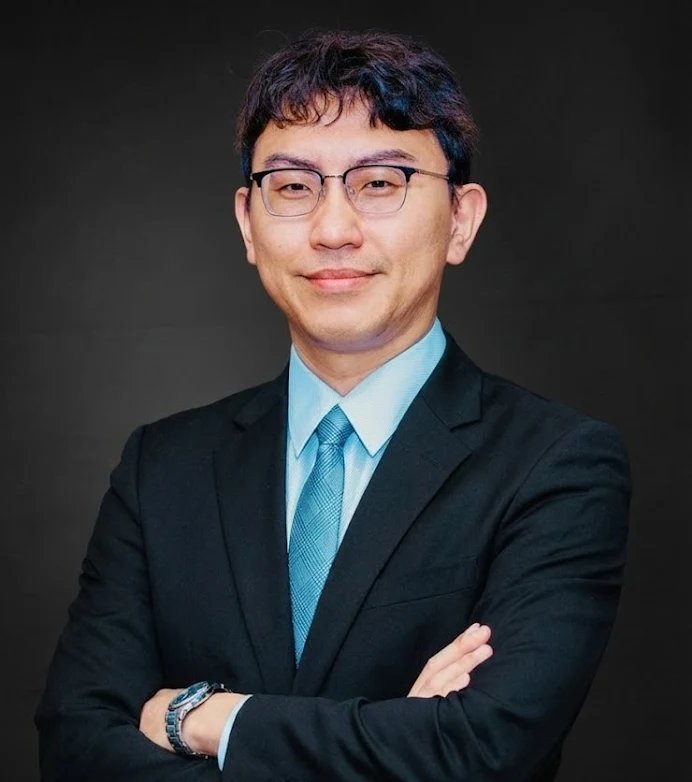
Cheng-Lin Tsai
Technical Director at the Taiwan AI Academy Foundation
Cheng-Lin Tsai is the Technical Director at the Taiwan AI Academy Foundation, specializing in Large Language Model (LLM) deployment and corporate strategy applications. Over the past three years, he has led Generative AI curriculum design and implemented an AI talent empowerment program, resulting in over 3,100 participants and 55 courses. He is dedicated to promoting the popularization of AI technology and enhancing workforce readiness in Asia.
The AIA mission: Closing the “Cognition-Practice” divide
Despite being a global hub for semiconductors and precision manufacturing, Taiwan faces a “cognition-practice gap.” Many organizations remain in a state of observation, struggling to internalize AI into decision-making processes. This shortfall stems not from a lack of engineering talent, but from a deficit in cross-disciplinary understanding and human-machine collaboration design.
The Taiwan AI Academy (AIA) was founded in 2018 to address this structural need. Having trained over 13,000 professionals across various sectors, AIA’s vision is clear: to make AI a tool for every professional. Between 2023 and 2025, AIA cultivated nearly 1,000 Generative AI specialists with practical expertise, fostering a learning ecosystem where web engineers become AI experts and environmental specialists translate domain knowledge into AI-driven decision-making languages.
The academy actively engages in policy dialogue, helping define the “AI Industrial Talent Recognition Guidelines” and launching the AIATCL™ certification to establish a common language for the market. The goal is to ensure that humans collaborate with AI rather than being dominated by it.
Cultural transformation: professionalism leads, AI follows
AIA’s core philosophy—“80% Domain Knowledge, 20% AI Literacy”—redefines the division of labor. Transformation is not about cold computing power, but about the “upgrade” of the human element.
Case studies illustrate this impact:
– Ya Tung Ready-Mixed Concrete: CEO Chin Chung-jen prioritized talent, sending 50 executives to AIA. This led to senior staff developing automation programs that reduced tasks from half a day to just 10 minutes, significantly boosting the company’s EPS.
– Taichung Fine Machinery: In collaboration with AIA and Feng Chia University, the company developed the “AIVM Quality Prediction System,” allowing machines to calculate errors via vibration signals during processing—a breakthrough in virtual measurement that cuts costs and enhances global competitiveness.
– Public and Civic Sector: Groups like Taiwan Secom and Goldsun Building Materials have launched “AI Literacy Consensus Camps” for executives. Simultaneously, the Directorate-General of Personnel Administration has enrolled nearly 500 high-ranking officials in AI strategy workshops to optimize government decision-making.
Civic AI: Literacy as a democratic foundation
As Generative AI becomes common, AIA is expanding its scope from professional training to “Universal AI Literacy” through the Civic AI Project. This initiative focuses on the ability to identify risks and understand responsibilities when AI impacts public rights.
The Civic AI project employs a three-track strategy:
1. Systematic Courses: Helping workers and students understand AI’s impact on their roles.
2. Open-Source Materials: Developing localized curricula focused on ethics and responsibility.
3. Seed Instructors: Empowering educators to bring AI literacy to every corner of society.
With support from partners like AVPN and Meta, the Civic AI project has trained over 26,000 people. Applications range from community colleges teaching seniors to non-profits like One-Forty using AI to assist Southeast Asian migrant workers with translation and job seeking.