Global Perspectives
This editorial draws on a conversation with local experts and sources.
Key Takeaways
– The Grand Egyptian Museum as a symbol of a new global stance
– Navigating multipolarity while maximizing autonomy
– Domestic challenges and major bets on strategic infrastructure
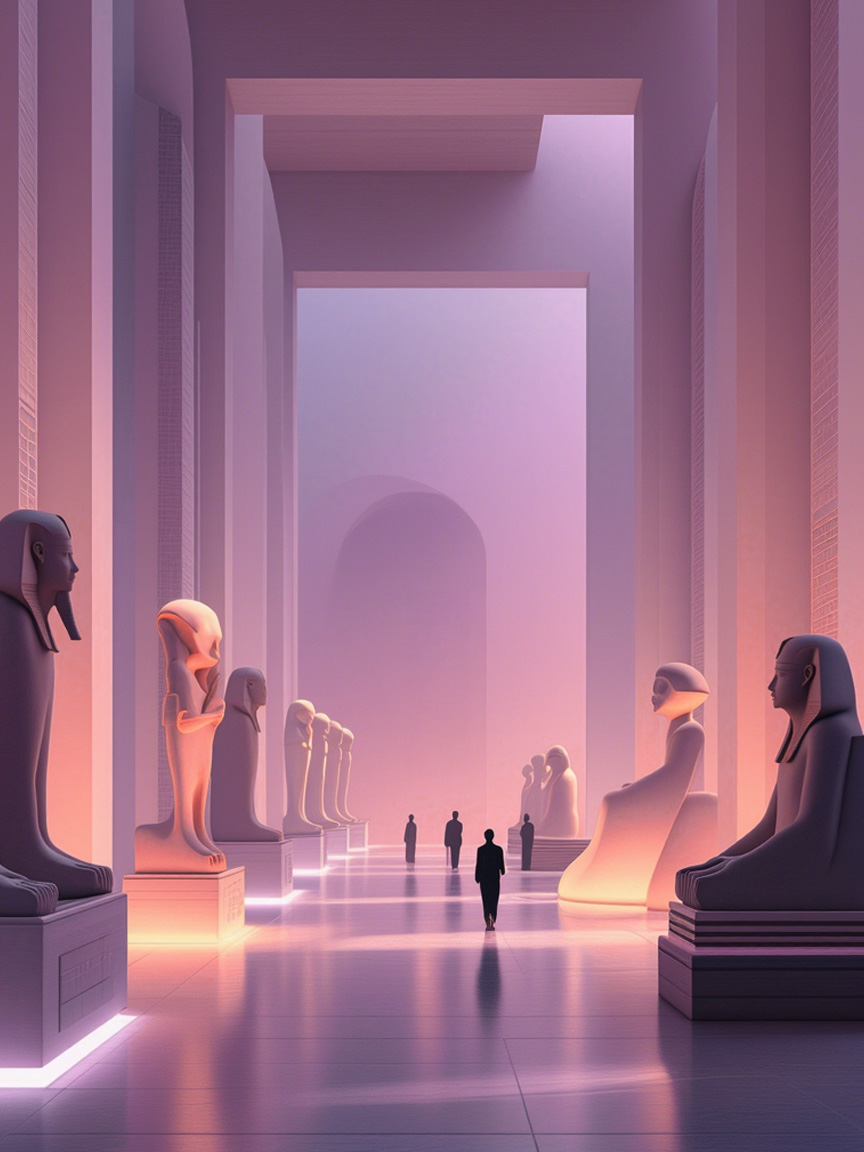
On November 1, Egypt unveiled the Grand Egyptian Museum with a ceremony that felt less like an opening and more like a restoration of civilizational ambition. After two decades of delays—revolution, pandemics, fiscal strain—the $1 billion complex now sits beside the pyramids like a contemporary counterpart. President Abdel Fattah al-Sisi framed the event as an assertion of identity: Egypt as guardian of antiquity and a stabilizing anchor in a region defined by volatility. Above Giza, drones formed a glowing declaration: Egypt: Land of Peace.
The GEM—quickly nicknamed the “Fourth Pyramid”—is not just a museum. Spanning half a million square meters, it acts as a national statement of intent: Egypt plans to build boldly even as its economy buckles under pressure. Inflation hovers near 20%; true unemployment is far higher than the official 7.4%. Nearly a third of Egyptians live below the poverty line. The country’s largest cultural landmark arises, therefore, not in a moment of prosperity but in one of palpable strain. That contrast gives the museum its political edge.
The war in Gaza pushed back the originally planned August opening, and when the unveiling finally happened, the symbolism was unmistakable. Representatives from Coptic, Muslim, and Sufi communities conveyed unity, while replicas of the Rosetta Stone and Nefertiti bust issued a subtle reminder of Egypt’s ongoing campaign for the return of its antiquities. Officials expect five million visitors annually and as much as $2 billion in revenue within two years—critical foreign currency for an economy increasingly plagued by shortages. Tourism is one of the few reliable engines left: 15.7 million visitors in 2024, with an official target of 30 million by 2030.
But focusing on the museum alone misses the larger shift underway. The GEM is the most visible symbol of a broader project: Egypt’s attempt to reposition itself economically and geopolitically as the global order fragments.
Egypt’s entry into BRICS in 2024 was less a pivot than a hedging strategy. A year on, the contours are clearer. Cairo now conducts more than a third of its trade with BRICS partners through currency-swap agreements with China, Russia, and India, easing its dependence on the dollar. Infrastructure—from the Alexandria Port expansion to Cairo’s metro network and the Dabaa nuclear plant—is receiving financing from the BRICS New Development Bank. Yet Egypt is not turning away from the West; it is seeking leverage. The EU expanded its support package to €7.4 billion in 2024, and Gulf states still anchor the country’s foreign reserves. Egypt’s approach is explicit: diversify partners, maximize autonomy, and ensure no single bloc can afford to let the country fail.
This same logic drives its infrastructure build-out. Egypt is constructing a 2,000-kilometer high-speed rail network linking 60 cities—one of the most ambitious projects of its kind—designed to connect the Red Sea to the Mediterranean and position the country as a logistics super-corridor. With the Suez Canal already facilitating up to 15% of global trade, the goal is to extend that advantage inland through new dry ports, integrated industrial zones, and logistics nodes.
The Grand Egyptian Museum embodies this duality—a vast, gleaming declaration of identity and intent, rising over a landscape that is still searching for stable ground.
Energy strategy follows suit. Cairo and Athens are advancing the GREGY submarine cable, intended to deliver 3,000 MW of green energy to Europe. The East Mediterranean Gas Forum, headquartered in Cairo, is coordinating regional gas exports, while new BP exploration agreements aim to offset dwindling local production. Together, these efforts sketch a future in which Egypt sees itself as an energy gateway, a digital hub, and a bridge between continents.
In parallel, the government is betting heavily on digital transformation. ICT investment has multiplied since 2020, with the sector targeting 7% of GDP. The domestic IT market is projected to nearly triple by 2031. The National AI Strategy seeks to embed artificial intelligence across tourism, logistics, and public administration. Under the banner of “Digital Egypt”, mobile-tower expansion and modernized postal centers signal an effort to streamline state capacity and attract global tech firms to a young, increasingly skilled workforce.
Yet one constraint overshadows all others: water. The commissioning of the Grand Ethiopian Renaissance Dam has altered the flow of the Blue Nile, a river that Egypt has long considered existential. After years of negotiations, no binding agreement exists. Cairo is accelerating desalination plants and irrigation reforms, but the structural water deficit remains vast—measured in billions of cubic meters.
Demographics amplify the stress. Egypt’s population has reached 116 million, half under 25. The economy must generate hundreds of thousands of jobs every year—a demand it rarely meets. Al-Sisi’s stance remains consistent: development first, even if it requires difficult trade-offs. Egypt in 2025 operates in this nexus of aspiration and constraint. It is building on a monumental scale while navigating deep economic fragility; diversifying alliances while relying heavily on external support; projecting confidence while confronting stark structural limits. The Grand Egyptian Museum embodies this duality—a vast, gleaming declaration of identity and intent, rising over a landscape that is still searching for stable ground.