
Language
Introduction
The alphabet you read in is not neutral. It determines what can be written easily, what must be approximated, and what disappears altogether. Every script is a filter—not only of sound, but of memory, legitimacy, and power.
Where Arabic created a form of linguistic cohesion among communities that already shared a worldview, Latin has achieved something structurally different: it moves across languages, religions, and cosmovisions that have almost nothing else in common, making different writing systems—if not fully interoperable—at least visually familiar to billions of people.As of today, Latin script is the world’s most widely used writing system. An estimated 4.7 to 4.9 billion people—roughly 70% of the global population—use it across more than 150 languages. Derived from the Western Greek alphabet in the seventh century BC, its 26 core letters travel left to right across the page, carrying with them an outsized portion of human communication.
Global Distribution of the Latin Script
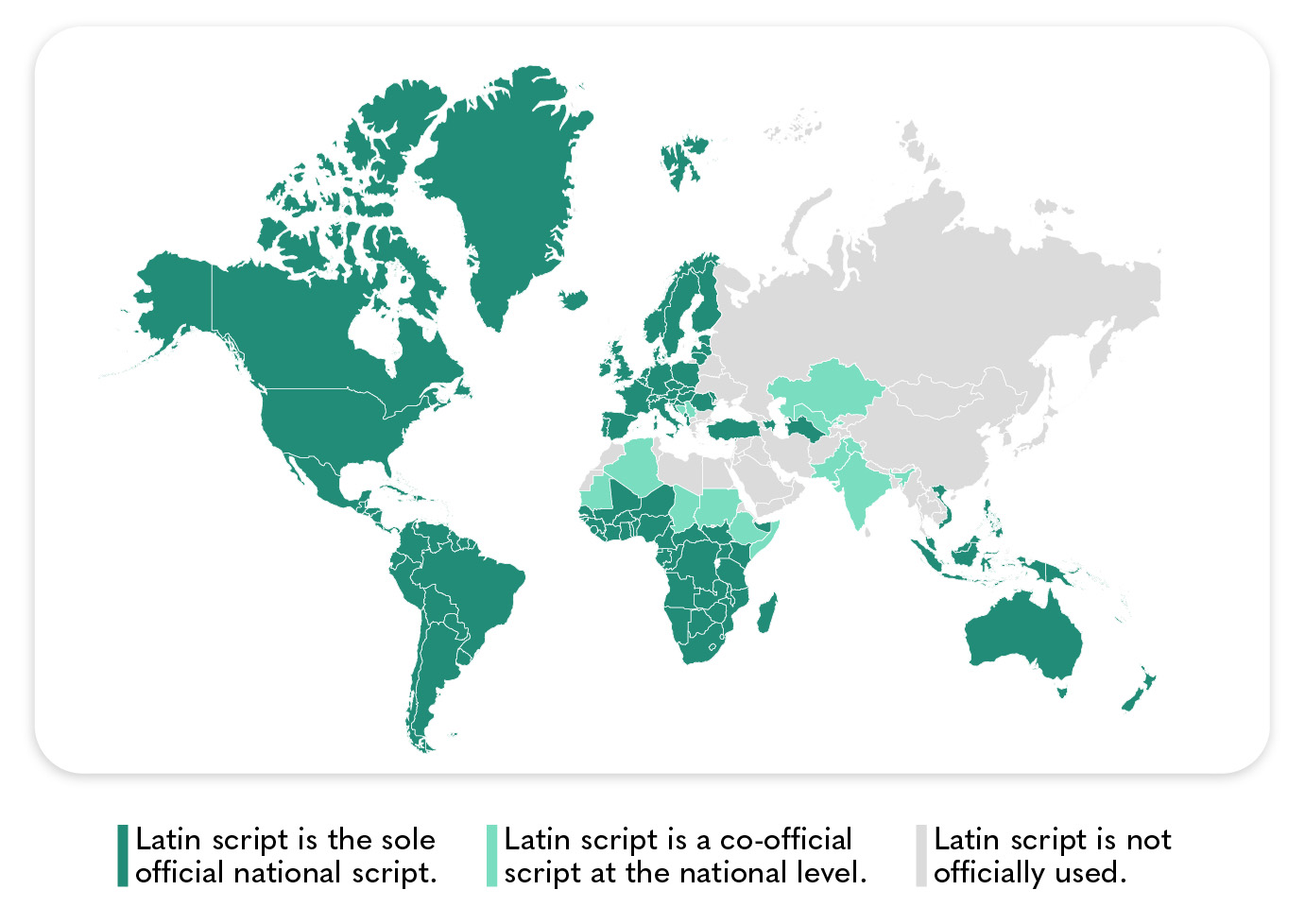
Source: Wikipedia
But this reach was not inevitable, nor innocent. Latin letters traveled with conquest and colonialism, with missionaries and printing presses, with telegraph cables and digital infrastructure. And sometimes, they traveled by choice—adopted by communities that decided to write a different future for their own nation. In each case, the script people use to record their history is among the most consequential decisions a culture can make.
As our collaborator Vaishnavi Murthy Yerkadithaya writes in her article for Imminent: “A script is more than a code for sound. It is a visual border that shapes how language is seen, archived, standardized, and ultimately valued. A change in script is never purely about aesthetics; it is a fundamental shift in how a culture is read and understood.”
Yet the script has rarely arrived as a perfect fit. Again and again, it has proven structurally incapable of containing the phonologies, epistemologies, and cosmovisions of the languages it was asked to carry—and so it has been broken open, extended, modified, reinvented. Dots, hooks, umlauts, diacritics, digraphs: the marks added to the Latin alphabet across centuries are not decorations. They are evidence of resistance, negotiation, and creative survival.
Latin’s perfection, then, is not a fixed state. It is a process—one of constant dissolution and reinvention. The four cases in this issue make that visible.
Script as Sovereignty

Writing, Power, and the Future of Language
By Vaishnavi Murthy Yerkadithaya
A script is more than a writing system—it shapes how languages are seen, valued, and remembered. From the oral traditions of South India to global script reforms, this article explores how writing systems function as instruments of power in an increasingly standardized world.
Malta

From Semitic Roots to Latin Letters
By Stephanie Debono
Maltese turns a Semitic language into Latin script, rewriting Arabic roots through European letters. The result is not a compromise but a linguistic hybrid where writing becomes a record of colonization, adaptation, and identity in constant negotiation.
Vietnam

Gateway to the Global
By Ngo Thanh Ha
Vietnam’s Quốc ngữ transformed a thousand years of Chinese-character writing into a Latin script—reshaping not just how a language is written, but how a nation reads itself. In doing so, it opened Vietnam to the world, carrying its language onto the global stage.
Türkiye

Rewriting a Nation
By Arzu Altınay
In 1928, Türkiye changed its alphabet—and with it, its future. Replacing Arabic script with Latin was not just a linguistic reform, but a radical act of modernization that reshaped literacy, identity, and the relationship between language and power.
Kazakhstan

Building Identity in the Digital Realm
By Timur Sulbayev
Kazakhstan’s shift from Cyrillic to the Latin alphabet is more than a script reform. Between Soviet legacy, Turkic identity, and digital globalization, the choice of letters becomes a question of sovereignty, belonging, and the future direction of the nation.